Due to the pandemic, several projects were put on hold in 2020. Nevertheless, ECOSS persevered and continued to serve diverse communities and small businesses. 2021 was a year of growth for ECOSS, with greater female representation in management and promotions of people of color into senior leadership positions. And as public health restrictions loosened, ECOSS’ trusted approach of in-person outreach returned. ECOSS programming served 429 community members and 422 businesses in 2021! Check out the summary of the year in this printable summary sheet.
ECOSS has seen many transitions in recent months, with many new energized voices joining and others moving onto new roles. One beloved ECOSS voice recently departed, but not before sharing some reflections on his time with ECOSS.
Ruben Chi Bertoni was ECOSS’ lead on multicultural outreach around residential stormwater solutions, working with King County and Seattle Public Utilities to make the region’s RainWise program more equitable. Not only was he an agent for change with project partners, he also was an advocate for more equitable practices internally at ECOSS.
Though we will miss seeing Ruben more regularly, we’ll still be connected as he moves into a similar role on the other side of the table at Seattle Public Utilities, working with environmental organizations like ECOSS around the RainWise program.
His is the story of ECOSS. Of being an immigrant looking to make a difference for BIPOC communities and being empowered around environmental sustainability. Here are some of his reflections below:
Ruben managed ECOSS’ multicultural outreach around residential stormwater solutions, like cisterns. Photo credit: Marcela Gara / Resource Media.
As I begin writing, I think about where I was in life back when I began working at ECOSS.
I was 23 back then. Working two jobs and going to school full-time. As a dreamer, I lived with many uncertainties, and particularly my professional future in this country. This took a toll on my self-confidence and feelings of security. But I always thought to myself that a college degree would be something I could take anywhere with me, so I kept on pushing, hoping things would turn out for the best.
My senior year at University of Washington, I found ECOSS while networking to find different organizations that did environmental justice work in the Duwamish Valley. After I graduated, things came together. ECOSS was looking for a new employee and President Obama at the time passed the DACA program. To me, ECOSS was the light at the end of the tunnel of living with fear, anxiety and uncertainty. And although this hasn’t gone away completely, ECOSS has supported me and my situation in an unconditional way where I felt heard and seen. Because of this, ECOSS is and will always be like a family to me.
When I started at ECOSS in September 2013, I worked with the Powerful Neighborhoods program. The program was very straightforward; change incandescent lightbulbs for LED ones and reduce energy usage. However, ECOSS managers decided that I could help with other programs. This was a great growth opportunity, but in my young mind I didn’t view it as such. It started with working on ECOSS’ outreach with the region’s RainWise program. Over time, I received more responsibilities and eventually became the manager for our RainWise work. I was supported and encouraged at every step of the way. Looking back, I didn’t realize that ECOSS was building me professionally as I learned how the program operated and where ECOSS stood in the bigger world of community outreach.
Through this story I learned very valuable lessons:
Self-confidence At ECOSS, I was able to safely build my self-confidence. My team and colleagues believed in me when I didn’t believe in myself. Seeing others encourage me and say “you can do it” really made the difference for me to feel comfortable with growth.
Finding my voice Many ECOSS colleagues will find this surprising, but I used to be a very shy kid. I think at ECOSS, I was able to get comfortable enough to share my ideas. Then I realized we live in a world where the voices of BIPOC communities are not often at the seat of the table in decision-making for programs that will affect them directly. Seeing this, I realized how much more important it is to speak up. We cannot speak for all communities, but adding a different perspective other than what is the status quo is a good start. Also, as ECOSS staff have more conversations with community members on our programs, we can take this feedback and incorporate them into our programming.
Collaboration ECOSS has always promoted the spirit of collaboration. At ECOSS, all staff participate in giving their perspectives on how to implement programs. To me, it has been extremely enriching to learn about other cultures and understating how programs need to flexible so that ECOSS can adjust its messaging or methods to better serve diverse audiences. It has also been extremely helpful to partner with other organizations and collaborate to expand our reach to immigrant communities.
ECOSS set up to talk stormwater pollution with their watershed model. Photo Credit: Sam Le.
Ruben also shared some of his favorite and funny moments while at ECOSS:
All the potlucks
All the happy hours
Doing outreach with the team
Telephone – one time for RainWise outreach, we were helping a Chinese homeowner who didn’t speak English. The only available contractor was Vietnamese and didn’t speak English. I remember sitting in the office hearing my Chinese and Vietnamese colleagues talking to each other to be the bridge to make the RainWise installation happen. It was like a game of telephone, and the message got from one end to the other end successfully
Eating a whole mooncake – for Chinese New Year, a colleague brought mooncakes. Apparently, you were supposed to cut them up and share them but I didn’t know this so I ate an entire mooncake (probably about 1,000 calories) on my own
Thank you Ruben for being with ECOSS for eight years! We look forward to seeing how you grow and continue to empower businesses and communities of color to be environmentally sustainable.
Joycelyn Chui worked with Chinese contractors and community members to advance stormwater solutions. Photo Credit: Charles Law / ECOSS.
This week is a bittersweet one for the ECOSS family, as this is the last week for a dear colleague and friend, Joycelyn Chui, who is leaving to pursue a Master’s degree in Public Health, with a focus on Environmental and Occupational Health at University of Washington this fall.
After joining in 2017 as a coordinator to work on Green Stormwater Infrastructure projects, recycling and composting outreach and more, Joycelyn quickly showed her passion and organizational skill for community engagement. In less than a year, she became a Multicultural Outreach Manager, leading projects with a focus on Mandarin- and Cantonese-speaking communities and businesses.
In her three years at ECOSS, Joycelyn has not only advanced ECOSS’ mission of sustainability for all, but also served as an inspiring role model for everyone at ECOSS with her charismatic, inclusive and candid leadership.
Before she departs, we had a chance to catch up with Joycelyn for some reflections on her time with ECOSS:
What was your favorite part about working at ECOSS? What will you miss the most?
My coworkers! At ECOSS, people are open minded, independent and we have a lot of trust among folks. I’ll miss the privilege and availability to try new things and projects. Lastly, I love and definitely will miss the flexible working schedule.
Joycelyn supported Mr. Liang in constructing Grattix boxes (rain garden in a box) at Equinox Studios. Photo Credit: William Chen / ECOSS.
How have your views on the environment evolved while working at ECOSS?
Unfortunately, my time at UW as a Fishery Sciences undergrad didn’t teach me anything about environmental injustice. Since I started working at ECOSS, I see firsthand how language barriers, technological divides, varied economic status, immigration status, etc. affect the communities we serve.
The topic of environmental protection can’t be silo-ed. There’s no way to do environmental protection, undo climate change or implement any environmental programs without addressing racial equity and social justice.
What are your biggest takeaways from your time at ECOSS?
The more you put in, the more you get out of it.
ECOSS is a lifestyle, beyond a job.
Skills learned: project management, environmental education, understanding how a nonprofit organization works.
There is so much more work to do about environmental equity!!!
Funny/memorable moments?
Group photo at the 2018 Water Festival, with emcee Aleksa Manila. Photo Credit: Sam Le.
LOTS!
Climbed up Formosan church’s roof to look at the roof structure, it was three floors high.
Water Festival. I was honestly surprised that ECOSS staff members gave me so much trust to run a festival.
Within the first month of working at ECOSS, I brought back six mooncakes. It’s meant to be shared among 4-8 people. Next day, I came to the office with one went missing. Turned out, Ruben ate a whole mooncake alone!!!
A RainWise contractor gave me two pounds of squid as token of appreciation
Doing outreach while having dim sum.
Did a simple photo shoot with Seattle Public Utilities. Next thing I knew, my face appeared in a lot of their collateral materials. Like their calendar, residential newsletter, website, even on The Stranger!
During the last week of my job, I had to help the RainWise team with running the contractor orientation. Charles’s ran into technical difficulties and ALL his PowerPoint slides lost audio tracks 15 minutes before the online orientation. We had to immediately pivot into narrating the slides! It worked great though 🙂
Where do you think the organization is headed? Or what do you hope to see in five years?
Be one of the leaders of environmental equity in Seattle.
Continue to be the cradle of environmental equity leaders.
Anything else you want to say?
The ECOSS experience is one of best things that has happened to me. I’m sad yet excited to leave to embark my next chapter of life. Thank you ECOSS!!!
We shall meet again someday! 後會有期!
Thank you Joycelyn for being part of the ECOSS family! We wish you well in your next adventures and look forward to seeing your future successes!
Language is one of the greatest barriers immigrants and refugees face in accessing resources, services and solutions that improve health outcomes and environmental well-being. When it comes to promoting clean water in the Puget Sound region, one of the ways this barrier manifests is in language access to Green Stormwater Infrastructure (GSI).
Rain gardens not only add beauty to a property, but also filter pollution from stormwater.
GSI such as rain gardens, cisterns and permeable pavement help protect local waters from stormwater pollution. This infrastructure is a great way for homeowners to contribute to Puget Sound’s health. However, the process for scoping, installing and maintaining GSI can be daunting for those unfamiliar, especially if English is not a native language.
Thus, to celebrate the 50th Anniversary of Earth Month, ECOSS staff have prepared three articles in Traditional Chinese, Spanish and Vietnamese:
ECOSS partners with Seattle Public Utilities and King County to increase access to the RainWise program and shape tools that deliver more equitable environmental solutions.
Polluted stormwater runoff is the greatest source of pollution to the Puget Sound and other local water bodies. This pollution not only threatens local wildlife like salmon and orcas, but also surrounding communities, such as those neighboring the Duwamish River, where water is central to their cultures.
The critical need for clean water is why Green Stormwater Infrastructure (GSI) is one of ECOSS’ core impact areas.
Grattix boxes enable the benefits of rain gardens on business properties. Photo Credit: William Chen / ECOSS.
ECOSS provides language support for community members to access RainWise rebates. Photo Credit: Ned Ahrens.
Helping diverse landscaping businesses become RainWise contractors not only promotes green careers, but also puts environmental solutions in neighborhoods that will benefit the most. Photo Credit: Sam Le.
A recent report from King County and Seattle Public Utilities highlighted recent accomplishments in green stormwater solutions, including features of ECOSS’ work in multicultural outreach, green career pathways development and industrial-scale stormwater solutions.
By building trust and relationships through shared language and cultural understanding, ECOSS empowers communities of color as environmental stewards, helps local businesses become more financially and environmentally sustainable, and advances the equity of environmental solutions.
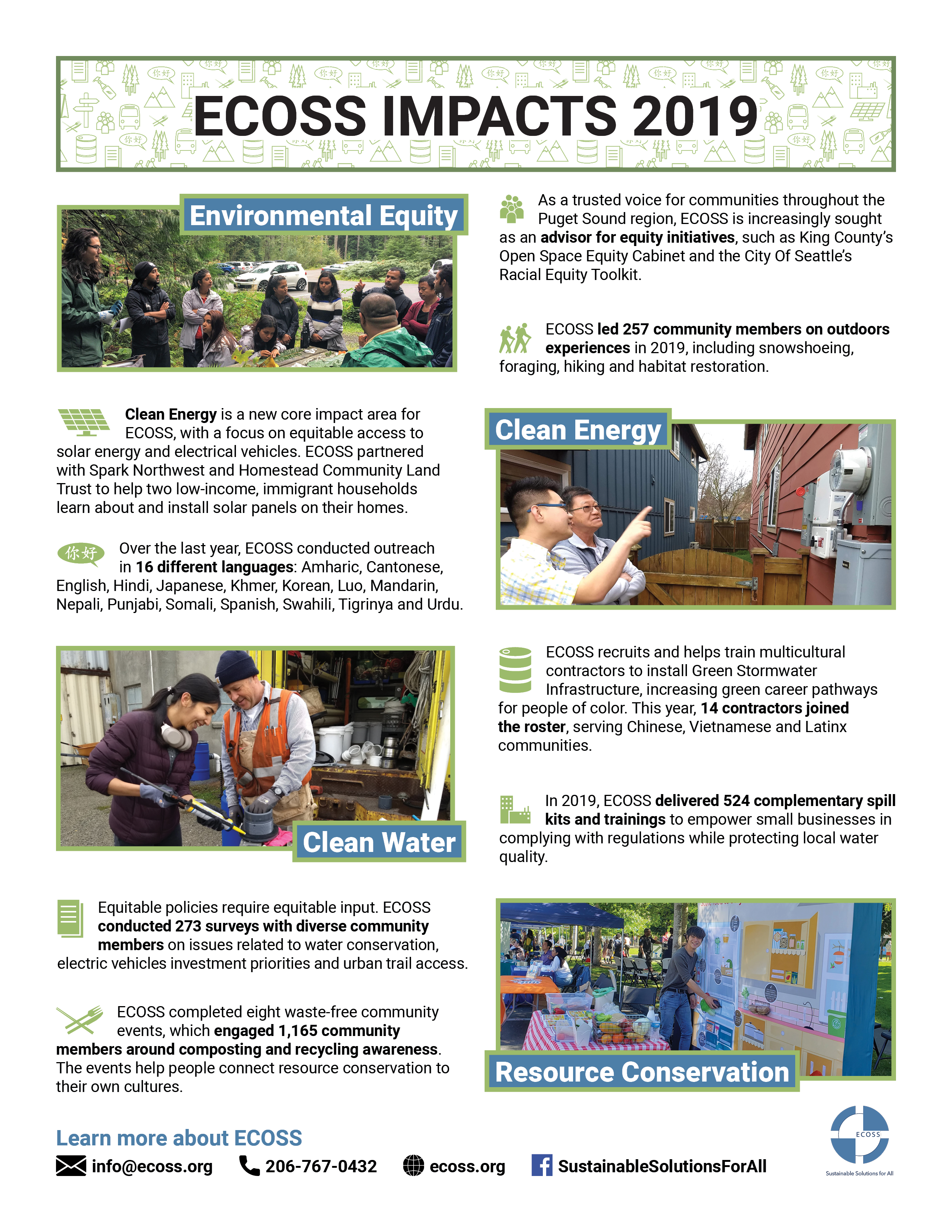
2019 ushered in a new core program, new equity roles and more! Check out a summary of ECOSS’ impacts below:
What does it take to center equity in Green Stormwater Infrastructure (GSI) projects? How can others replicate successful community engagement models?
ECOSS’ many years of multicultural education and outreach have broadened the inclusion of communities of color around rain gardens and cisterns, including pioneering installations for community spaces and businesses. These are key examples of Green Stormwater Infrastructure (GSI), which have provided home improvements and green jobs in some of Seattle’s most vulnerable communities while reducing the amount of polluted stormwater runoff entering the Duwamish River and other local waters. What does it take to center equity in GSI projects? How can others replicate ECOSS’ successful community engagement models?
A recent Green Infrastructure Partnerships (GRIP) Panel featuring ECOSS and partners in King County’s RainWise program tackled these questions with an audience of municipalities and organizations passionate about GSI.
RainWise managers and ECOSS’ multicultural outreach team led the GRIP Panel. Photo Credit: William Chen / ECOSS.
Conversation circled around a central theme: bridging gaps. Economic, cultural, language and more. GSI installations are expensive for both property owners and the contractors that install them. For low-income residents, contractors commonly must front installation costs before being reimbursed for materials months later. For property owners, only certain basins are qualified for the RainWise financial rebate. When these financial hurdles arose, ECOSS helped find solutions, such as leveraging other grant opportunities.
But financials are only part of the journey. Contractors that want to work with RainWise must first get trained, which is only offered in English. ECOSS recruits contractors from the communities that it serves, then joins them in training to act as interpreters and mentors. Similarly, ECOSS walks property owners through the RainWise paperwork and processes. The GRIP panel illuminated the work and dedication that is required to overcome the barriers to making GSI accessible for all.
The audience included municipalities, nonprofits and others working closely with Green Stormwater Infrastructure. Photo Credit: William Chen / ECOSS.
The setting for the panel could not have been more appropriate. Co Lam Temple is a central location for the local Vietnamese community and the site of several cisterns that ECOSS helped establish. It also illustrates the challenges of expanding GSI access. The temple is not located in a RainWise-eligible basin. Many community members were not native English speakers nor familiar with GSI. ECOSS helped bridge these economic and language gaps while building trust within the community. After a productive discussion of how other municipalities could help promote equitable GSI, ECOSS led a tour of Co Lam Temple to show how the cisterns were being integrated into the temple and broader community.
To bridge gaps, ECOSS builds personal connections with communities. The installation at Co Lam was a success in large part because an ECOSS staff member was already a regular attendee of the temple. When he approached the head monks about installing GSI, it wasn’t as an outsider offering a service; it was as a community member suggesting a solution.
Cisterns are now a prominent feature around the Co Lam Temple, accompanied by educational signage in English and Vietnamese. Photo Credit: William Chen / ECOSS.
ECOSS has grand visions for further advancing the equity of GSI installations. A revolving fund would expedite contractor payment by reimbursing installation costs up front and refilling from completed installations. Additionally, an ECOSS-administered fund would build on native language capacities and rapport with multicultural contractors to lower bureaucratic barriers.
The GRIP Panel was a precious opportunity to share insight on ECOSS’ equity lens with other cities, counties and organizations. The buzz of excitement after the events of the day provided hope that the lessons learned will inspire similar programs across Puget Sound.
Stormwater runoff is the #1 source of pollution in Puget Sound, threatening human, fish and aquatic life. But how does rain result in pollution? One contributor is in how cities manage their sewage.
Seattle implemented its first centralized sewer system in the early 1900s ahead of a premier world fair. Rather than having separate pipes for sewage and stormwater, Seattle’s chosen system collected both sewage and stormwater through the same pipe. Generally, there was no issue as the combined sewage was treated at water treatment plants.
Sewage is directed to a water treatment plant during dry weather.
However, heavy rain overloaded this system, dumping an overflow of untreated sewage and stormwater into Puget Sound, the Duwamish River and other local waters. The combined sewage included human waste, heavy metals from roads and pollutants accumulated on roofs. The polluted water is highly toxic to salmon, orcas and other aquatic wildlife. Moreover, it is detrimental to people swimming in the waters or fishing in urban rivers.
During large storms, stormwater is combined with sewage in the same pipe, and the increased volume overflows straight into nearby waters.
The archaic combined sewer systems still exist today. Construction of new combined sewer systems stopped in the 1950s, but older systems have yet to be completely replaced. And with population growth and urbanization in Puget Sound, combined sewer overflow has only become more polluted.
Green Stormwater Infrastructure (GSI) such as rain gardens and cisterns reduce the amount of stormwater entering the combined sewers. More combined sewage is captured by the sewer system and treated properly, rather than going into Puget Sound waters.
Green Stormwater Infrastructure (GSI) manages stormwater so that sewer systems are less likely to overflow.
ECOSS engages multicultural communities to raise awareness about GSI opportunities for property owners so that communities of color can be included in the solutions for clean water and healthier communities. Furthermore, ECOSS recruits and guides multicultural contractors through training to install cisterns and rain gardens. These green career pathways promote small businesses of color and ensure that the benefits of GSI solutions are reaching Puget Sound’s most vulnerable communities.
The Port of Seattle honored ECOSS as an Environmental Excellence Awardee!
Video by Port of Seattle with footage and photos contributed by ECOSS and Sam Le.
ECOSS’ programs are as diverse as the communities and businesses it serves. From clean energy to waste management, outdoor recreation to stormwater education, ECOSS provides access to environmental solutions to small businesses and marginalized communities. By working from within the communities that are most-impacted by climate injustices, ECOSS bridges gaps among industry, government and communities in ways that respect people’s cultures and lifestyles.
The Port of Seattle’s Environmental Excellence Award celebrates “the dedication of local partners to engage in healthier communities for cleaner air and cleaner water and to invest in enhanced energy efficiency.”
The Port of Seattle recently honored ECOSS with an Environmental Excellence Award for achievements in environmental equity! ECOSS envisions sustainable businesses and thriving communities supported by equitable environmental solutions. The award symbolizes that ECOSS is on the right track in addressing environmental injustices.
ECOSS receiving the Environmental Excellence Award with Port commissioners and staff.
ECOSS joined other environmental leaders, including small businesses recognized for their transition to clean energy and transportation heavyweight Lyft that is greening their rideshare service.
Congratulations to Young’s Restaurant and The Wilderness Society for being two of 2019’s Green Globe Awardees!
Young’s Restaurant family with ECOSS partner.Photo Credit: ECOSS.
Presented by King County, the Green Globe Award recognizes outstanding leadership in environmental stewardship. It is the County’s highest honor for local environmental efforts.
The Wilderness Society and ECOSS partners. Photo Credit: Ned Ahrens / King County.
The Wilderness Society partnered with ECOSS to conduct outreach around the Trailhead Direct public transit service within historically underserved communities of color. This affordable alternative to driving provides greater access to the natural beauty that the Pacific Northwest has to offer. With support form The Wilderness Society and King County Parks, ECOSS extended awareness of the service into the Bhutanese, Latinx, Korean and Khmer communities of the Greater Seattle area.
Dow Constantine. Photo Credit: ECOSS.
“Throughout King County, people, businesses and nonprofits are doing extraordinary work to protect the spectacular natural environment that is central to our identity and our quality of life,” said Executive Constantine. “The Green Globe Award recipients we honor today inspire and challenge us to leave this special place even better for future generations.”
Congratulations again to Young’s Restaurant and The Wilderness Society. Read more about their work and ECOSS’ role in promoting outdoors access and environmental equity.