Due to the pandemic, several projects were put on hold in 2020. Nevertheless, ECOSS persevered and continued to serve diverse communities and small businesses. 2021 was a year of growth for ECOSS, with greater female representation in management and promotions of people of color into senior leadership positions. And as public health restrictions loosened, ECOSS’ trusted approach of in-person outreach returned. ECOSS programming served 429 community members and 422 businesses in 2021! Check out the summary of the year in this printable summary sheet.
Compared to many American cities, Seattle has a fairly robust recycling and composting system. The City of Seattle also provides resources to educate residents and businesses. In addition to physical fliers, there is an online search tool.
ECOSS often visits Seattle’s Chinatown-International District to work with the restaurants there, many of which are owned by immigrants and refugees. Photo Credit: ECOSS.
However, with a robust system comes constantly changing rules, such as regulations around plastic bags, Styrofoam, takeout containers and more. For small businesses, especially when the owner or staff don’t speak English as a first language, it can be challenging to stay up to date with all the changes. ECOSS helps residents and small businesses adapt to these changes, and advocates for racial equity, such as language access and culturally-relevant education. Yet, it’s difficult for these suggestions to change government policies systemically.
Seattle Public Utilities (SPU) is ECOSS’ main client for solid waste management outreach, and they are stepping up when it comes to equitable engagement. By law, SPU can demand fines be paid for businesses that aren’t in compliance with recycling/composting regulations. However, this would inequitably harm business owners of color, many of whom face language and cultural barriers to adapting to Seattle’s regulations. Rather, SPU is spending resources internally to promote more equitable practices and externally for community-based organizations like ECOSS to ensure that commercial businesses have fair opportunities to recycling and composting education and resources before being hit with punitive fines. So what does that look like?
Enter “Targeted Universalism,” a framework created by UC Berkeley professor john a. powell as a model for promoting equity in policies and strategies. SPU has adopted this framework to guide their outreach efforts with businesses around recycling and composting compliance. The idea is that suppose there is a broad, universal goal to achieve – in SPU’s case, it’s 80% of all businesses complying with solid waste regulations. To reach this goal, there must be targeted solutions that recognize how different segments of the population are situated relative to that goal. For example, a takeout place will have different challenges from a sit-down restaurant. A Mexican-owned business will have different questions from a Vietnamese-owned one. Without a framework like Targeted Universalism, fining noncompliant businesses will unintentionally and unfairly target businesses of color due to inherent language and cultural barriers.
In practice, the framework greatly aligns with the ECOSS approach of recognizing the diversity among and within underserved communities and promoting culturally-relevant engagement. Here’s an example within the Korean community. Multicultural Program Manager David Han, who manages this project from SPU, was tasked with learning about how to improve compliance among Korean food-service businesses. Through outreach to 20 Korean-owned restaurants, David learned their lack of compliance was a simple difference in how compost was defined in Seattle versus their home country.
Understanding how to dispose of waste can be a daunting task. Seattle Public Utilities provides illustrative fliers to help businesses and community members determine what goes where. Photo Credit: Seattle Public Utilities.
Food waste is handled in its own cycle in South Korea. Due to a language barrier, David’s sample of Korean restaurants conflated compost with food waste. It thus didn’t make sense for Korean business owners to go through the additional mental and logistic effort to implement composting. David quickly picked up on this cultural difference and helped these businesses learn how other waste such as wooden chopsticks, used napkins and more could be redirected to composting, saving businesses money in the process.
Insights like these will inform engagement with that segment of Korean businesses throughout Seattle. In total, there are dozens of these segments, divided by type of food-service, geography, language and more. Through targeted engagement like what ECOSS accomplished, each segment can reach 80% compliance with education and solutions that are relevant to each community. By the time each segment reaches 80% recycling and composting compliance, there will be universal compliance of 80% or more – a win for the city that doesn’t come at the expense of underserved communities.
Environmental equity is often much easier said than done. With a framework like Targeted Universalism, there is clarity on how well the goal of equity is being met. ECOSS will continue to push for mindsets like this one so that there can be sustainable solutions for all.
We at ECOSS loved sharing community and business success stories with you at 2020’s Sustainable Futures Fest. In case you missed it, you can check it out here. ECOSS’ Sustainable Futures Fest returns with more exciting activities in October that highlight how communities and businesses are empowered to be environmentally sustainable.
2020 was a unique year that laid bare the inequities that BIPOC communities face in not only environmental disparities, but also health disparities, access to information and more. The strengths that enable ECOSS to be a leader in environmental equity played a central role in response the COVID-19 pandemic: trusted relationships with frontline communities; shared culture and language; and bridges with industry, community and government.
ECOSS has served 170 businesses and 100 community members through its COVID outreach projects that address financial, technology and information gaps. Additionally, ECOSS continued to strive for its vision of thriving healthy communities despite the new challenges to outreach work. ECOSS’ environmental outreach served over 2,500 community members and business owners in 2020.
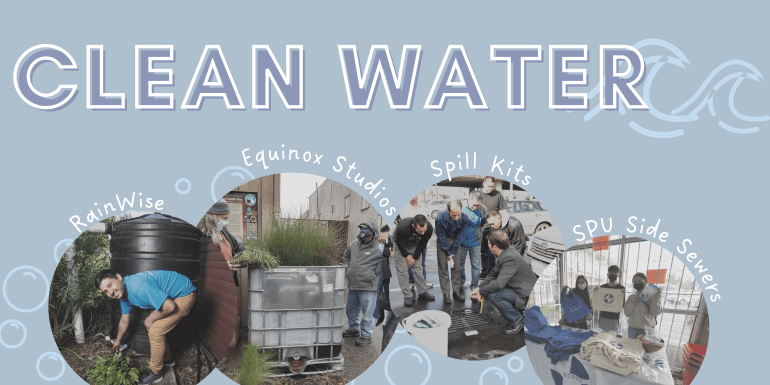
Joycelyn Chui worked with Chinese contractors and community members to advance stormwater solutions. Photo Credit: Charles Law / ECOSS.
This week is a bittersweet one for the ECOSS family, as this is the last week for a dear colleague and friend, Joycelyn Chui, who is leaving to pursue a Master’s degree in Public Health, with a focus on Environmental and Occupational Health at University of Washington this fall.
After joining in 2017 as a coordinator to work on Green Stormwater Infrastructure projects, recycling and composting outreach and more, Joycelyn quickly showed her passion and organizational skill for community engagement. In less than a year, she became a Multicultural Outreach Manager, leading projects with a focus on Mandarin- and Cantonese-speaking communities and businesses.
In her three years at ECOSS, Joycelyn has not only advanced ECOSS’ mission of sustainability for all, but also served as an inspiring role model for everyone at ECOSS with her charismatic, inclusive and candid leadership.
Before she departs, we had a chance to catch up with Joycelyn for some reflections on her time with ECOSS:
What was your favorite part about working at ECOSS? What will you miss the most?
My coworkers! At ECOSS, people are open minded, independent and we have a lot of trust among folks. I’ll miss the privilege and availability to try new things and projects. Lastly, I love and definitely will miss the flexible working schedule.
Joycelyn supported Mr. Liang in constructing Grattix boxes (rain garden in a box) at Equinox Studios. Photo Credit: William Chen / ECOSS.
How have your views on the environment evolved while working at ECOSS?
Unfortunately, my time at UW as a Fishery Sciences undergrad didn’t teach me anything about environmental injustice. Since I started working at ECOSS, I see firsthand how language barriers, technological divides, varied economic status, immigration status, etc. affect the communities we serve.
The topic of environmental protection can’t be silo-ed. There’s no way to do environmental protection, undo climate change or implement any environmental programs without addressing racial equity and social justice.
What are your biggest takeaways from your time at ECOSS?
The more you put in, the more you get out of it.
ECOSS is a lifestyle, beyond a job.
Skills learned: project management, environmental education, understanding how a nonprofit organization works.
There is so much more work to do about environmental equity!!!
Funny/memorable moments?
Group photo at the 2018 Water Festival, with emcee Aleksa Manila. Photo Credit: Sam Le.
LOTS!
Climbed up Formosan church’s roof to look at the roof structure, it was three floors high.
Water Festival. I was honestly surprised that ECOSS staff members gave me so much trust to run a festival.
Within the first month of working at ECOSS, I brought back six mooncakes. It’s meant to be shared among 4-8 people. Next day, I came to the office with one went missing. Turned out, Ruben ate a whole mooncake alone!!!
A RainWise contractor gave me two pounds of squid as token of appreciation
Doing outreach while having dim sum.
Did a simple photo shoot with Seattle Public Utilities. Next thing I knew, my face appeared in a lot of their collateral materials. Like their calendar, residential newsletter, website, even on The Stranger!
During the last week of my job, I had to help the RainWise team with running the contractor orientation. Charles’s ran into technical difficulties and ALL his PowerPoint slides lost audio tracks 15 minutes before the online orientation. We had to immediately pivot into narrating the slides! It worked great though 🙂
Where do you think the organization is headed? Or what do you hope to see in five years?
Be one of the leaders of environmental equity in Seattle.
Continue to be the cradle of environmental equity leaders.
Anything else you want to say?
The ECOSS experience is one of best things that has happened to me. I’m sad yet excited to leave to embark my next chapter of life. Thank you ECOSS!!!
We shall meet again someday! 後會有期!
Thank you Joycelyn for being part of the ECOSS family! We wish you well in your next adventures and look forward to seeing your future successes!
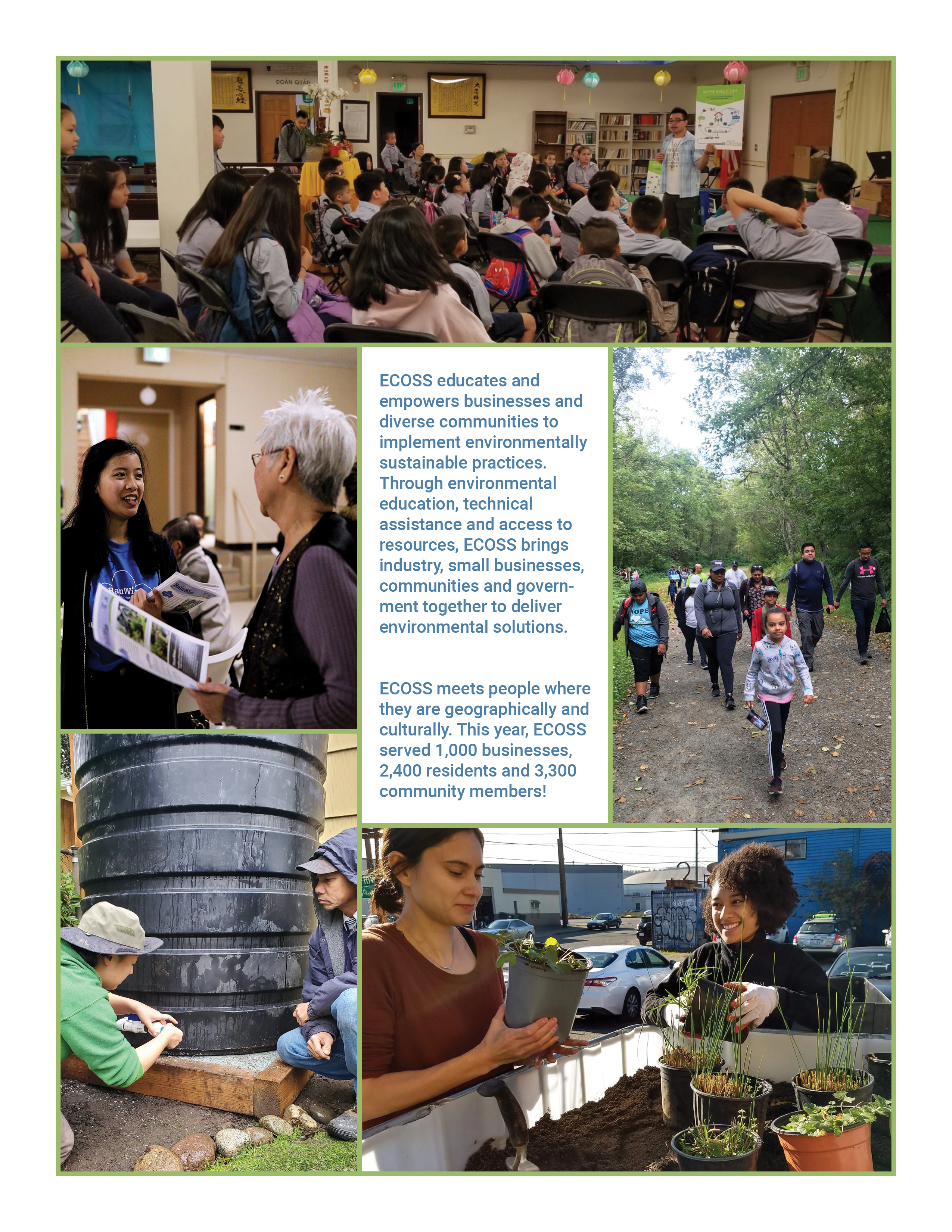
By building trust and relationships through shared language and cultural understanding, ECOSS empowers communities of color as environmental stewards, helps local businesses become more financially and environmentally sustainable, and advances the equity of environmental solutions.
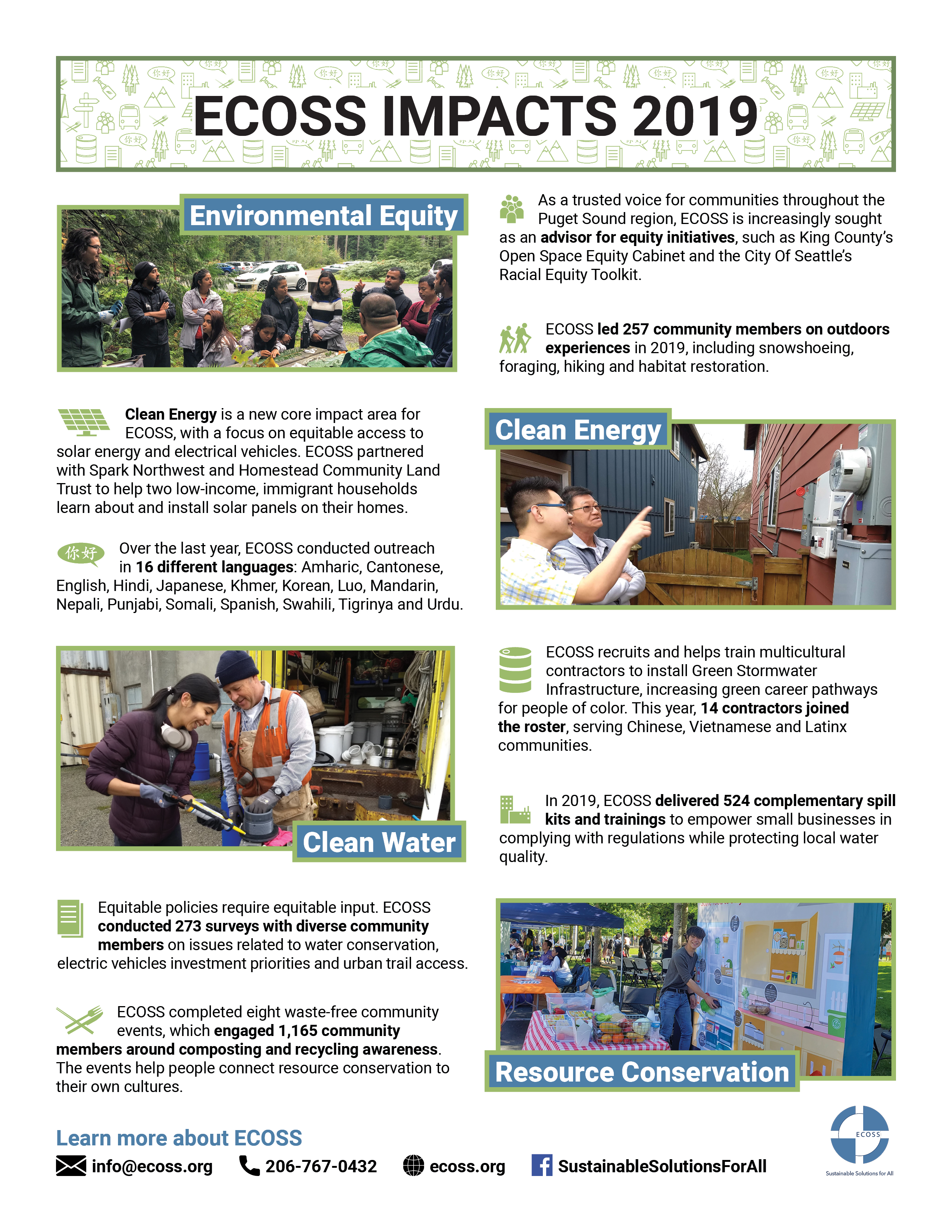
2019 ushered in a new core program, new equity roles and more! Check out a summary of ECOSS’ impacts below:
The Port of Seattle honored ECOSS as an Environmental Excellence Awardee!
Video by Port of Seattle with footage and photos contributed by ECOSS and Sam Le.
ECOSS’ programs are as diverse as the communities and businesses it serves. From clean energy to waste management, outdoor recreation to stormwater education, ECOSS provides access to environmental solutions to small businesses and marginalized communities. By working from within the communities that are most-impacted by climate injustices, ECOSS bridges gaps among industry, government and communities in ways that respect people’s cultures and lifestyles.
The Port of Seattle’s Environmental Excellence Award celebrates “the dedication of local partners to engage in healthier communities for cleaner air and cleaner water and to invest in enhanced energy efficiency.”
The Port of Seattle recently honored ECOSS with an Environmental Excellence Award for achievements in environmental equity! ECOSS envisions sustainable businesses and thriving communities supported by equitable environmental solutions. The award symbolizes that ECOSS is on the right track in addressing environmental injustices.
ECOSS receiving the Environmental Excellence Award with Port commissioners and staff.
ECOSS joined other environmental leaders, including small businesses recognized for their transition to clean energy and transportation heavyweight Lyft that is greening their rideshare service.
There’s a Chinese saying, 治標不治本 ; simply treating the symptoms to a problem does not solve the root cause. And right now, businesses are stuck addressing food waste symptoms.
Seattle is no stranger to environmentally sustainable policies. The city enacted a plastic bag ban in 2012. And in 2018, Seattle was the first major U.S. city to ban plastic straws and utensils in food service businesses. These policies are steps forward to a cleaner, healthier environment. But how effective are they in practice? And how equitable is the burden to comply?
ECOSS partners with Seattle Public Utilities to conduct outreach with small, minority-owned food service businesses about recycling and composting. Over the course of several visits, ECOSS works with each business in their native language to understand Seattle’s recycling and composting policies, implement operations that meet the city’s regulations and adapt to new initiatives.
Signage in multiple languages guide customers in sorting recyclables, compostables and durables away from the waste bin.
By visiting businesses repeatedly, ECOSS builds relationships with the owners. These relationships in turn build trust as owners become familiar with ECOSS staff. Businesses become more eager to work with ECOSS and change behavior.
Repeat visits also enable business owners to discuss the challenges they face with ECOSS. Large businesses more often have the capacity to anticipate and adapt to changing policies and trends. But small businesses face numerous barriers to advancing recycling and composting capacity. Crucially, food service businesses are constrained by distributors’ supplies. Not all businesses are located near a distributor that supply compostable utensils or reusable straws. The compostable options can be two to three times more expensive than their plastic counterparts even when the distributor does supply. And yes, the city can do little to stop distributors from carrying plastic straws and utensils. Ultimately, small businesses feel like they are simply being punished for their good environmental deeds.
ECOSS promotes waste reduction by providing compostable utensils for multicultural events. Photo Credit: Sam Le.
These barriers create a gap between understanding zero food waste versus implementing and operating the processes necessary to realize zero food waste. Since 2014, ECOSS has helped businesses establish and increase their recycling and composting capacity. Businesses fully understand the importance of zero food waste and how to comply with regulations, but there’s a limit to their recycling and composting capacity. In addition to the above challenges, recycling and composting pickup is not continuous and businesses only have so much space to store their waste. ECOSS has shifted to education around waste reduction, compostable, recyclable or otherwise, rather than simply sorting waste properly.
Without systemic changes in the policies that govern waste creation and management – such as incentivizing compostable utensils throughout the entire supply chain – Seattle’s growth as an environmentally sustainable hub will be stunted. Until local, regional and state policies engender more accessible and equitable waste management solutions, ECOSS is helping relieve symptoms of urban waste management.
What does meditation and recycling have in common? Perhaps surprisingly, quite a lot.
ECOSS recently partnered with community leaders Stephanie Ung and Venerable Sok Theavy to host an environmental health workshop at a local Cambodian Temple for community members and temple monks.
The workshop began by asking attendees to envision a healthy neighborhood and illustrate their visions through drawing and talking to each other. This exercise formed the foundation for discussing waste streams. Where does our trash go? How do we minimize the impact of our waste on the healthy neighborhoods we envision?
Community members gather round at the Cambodian temple to discuss recycling and composting. Photo Credit: Venerable Sok Theavy.
Sorting games show where different items should be disposed. Photo Credit: Joycelyn Chui / ECOSS.
But immigrants and refugees who did not grow up in a recycling and composting-centric culture face greater barriers in participating. ECOSS goes to where communities already congregate to engage them in their native languages around sustainability issues. Through sorting games, community members interactively learned about recycling and composting. The environmental health workshop posed the challenge of waste reduction as a community undertaking rather than an individual one. The environment impacts every aspect of our lives – it’s literally what society is built on and in. By connecting outreach to a community’s culture, ECOSS bridges the gap between environmental stewardship and people’s values and traditions.
A meditative walk through the Cambodian temple. Photo Credit: Venerable Sok Theavy.
During a meditative walk through the temple, Venerable Sok Theavy encouraged people to be mindful of every step, paying attention to when they lift the foot and when they place the foot back down on the earth. Analogously, the workshop asked attendees to be mindful of what they were consuming, what waste they were creating and how that waste impacts the environment.
Just as every step we take leaves a mark on the ground, every action we make leaves a mark on the environment.
Blue bins are now practically synonymous with recycling. Many know that soda cans and old newspapers go into recycling bins, destined to become other useful products.
But what about old electronics? Emptied propane tanks? Scrap metal leftover from a home project? These and many other materials can be recycled too, though often not as easily. Since 2016, ECOSS has worked with the City of Kent to help King County residents recycle less-common items such as refrigerators, concrete, tires and mattresses.
Cars lining up to drop off recyclable items and materials for a Kent recycling event. Photo Credit: Tony Donati.
Kent recycling event. Photo Credit: Tony Donati.
From lawnmowers to microwaves, Kent recycling events help people be environmentally-responsible. Photo Credit: Tony Donati.
In 2018, we helped with three free community recycling events, which collectively welcomed over 4,000 vehicles full of recyclables. The events altogether collected over 3,000 toilets, mattresses and other individual items plus over 300 tons of material like scrap metal, bulky wood debris and concrete!
ECOSS strives to make environmentally sustainable practices accessible to all. Many people are interested in reducing their environmental impact. We empower people to act on those interests and to let others know how they can make a difference, too.