14 Native Plants ECOSS Incorporated into Restoration Work at Seward Park

ECOSS has been working with communities to restore a habitat site at Seward Park. The site was previously covered in Himalayan Blackberries, which are a non-native species that out-competes understory vegetation and makes it difficult for trees to grow due to the thick foliage. According to kingcounty.gov, the Himalayan blackberry is a Class C noxious weed. Although control of Himalayan Blackberry is not required, it is recommended in protected wilderness areas and in natural lands that are being restored to native vegetation because of the invasiveness of these species.

Last summer, ECOSS invited immigrant, refugee, and BIPOC communities to come together for a work party to restore the land and clear out Himalayan Blackberries at a site in Seward. This month, 14 adults and 3 youths from the community came together with ECOSS and Mountains to Sound Greenway Trust for a planting event. The day included reflection on how we can form impactful connections to the land, forming new relationships with staff and community, and planting native trees and shrubs to restore the land. By the end of the event, about 135 native plants had been planted at the site. Community members were also invited to take a native plant with them to plant at home.

I was mindful when ordering the plants for this project– typically in restoration work there isn’t a lot of variety or diversity in the plants that are planted, so I took this opportunity to incorporate plants of importance that most people don’t typically see or work with. It affirms my passion to grow this impact area in our organization and to be able to provide more opportunities to our community to steward the land whether it’s in a leisurely setting or a skilled professional setting.

Miranda perez, Senior Program Manager

Here are 14 native species that ECOSS planted with the community at Seward Park

Compiled by Miranda Perez, ECOSS Senior Program Manager, with information from Plants of the Pacific Northwest by Jim Pojar and Andy MacKinnon.

Trees:

  • Red alder, alnus rubra—large deciduous; considered the best wood for smoking salmon and other fish and valued for its medicinal qualities in making a tonic for tuberculosis and respiratory ailments; improves disturbed soil by fixing atmospheric nitrogen into the soil
  • Cascara, rhamnus purshiana—tall shrub/small tree; the bark was boiled and drunk as a strong laxative tea by Nuxalk, Coast Salish, Quilete, Nuu-chah-nulth, Kwakwaka’wakw and other groups. It has been scientifically proven to be an effective laxative
  • Shore pine, pinus contorta—large conifer; The Haida used peeled sheets of the bark as splints for broken limbs; Also used medicinally by Nuxalk, Coast Salish, Nuu-chah-nulth, Kwakwaka’wakw, Haida, Tsimshian, and Tlingit as gum, and applied to cuts as well as the skin to treat heart pain and rheumatism.
  • Western red cedar, thuja plicata—large conifer; Trees of life are held with high respect for their healing and spiritual powers by west coast peoples; cedars were extraordinarily useful to indigenous people of PNW and played key roles culturally, providing for the people from birth to death, cradles to coffins.

Shrubs:

  • Oregon grape, mahonia nervosa—yellow blooms; the tart berries were eaten (with great caution as they are very potent) in a mixture with salal berries or other sweet fruit, or medicinally for liver, gall bladder, and eye problems; the bark was used to make a bright yellow dye for basket materials
  • Twinberry, lonicera involucrate—yellow blooms; the blackberries are not considered edible and often considered taboo as the Kwakwaka’wakw believed eating them would cause one to become unable to speak; The Quileute and Kwakwaka’wakw used the berries as a black pigment, and the Haida rubbed the berries on their scalp to prevent grey hairs.
  • Salal, gaultheria shallon—white/pink blooms; the dark juicy berries were important to many groups eaten fresh and dried into cakes; young leaves were chewed as a hunger suppressant by the Ditidaht.

Herbs and Flowers:

  • Entire leaved gumweed, grindelia integrifolia—yellow bloom; important to many Coast Salish peoples, used medicinally to treat asthma, bronchitis, colic.; great pollinator plant
  • Goatsbeard, aruncus diocius—white blooms; the Tlingit and Makah prepared the root for curing diseases of the blood (commonly gonorrhea); the Lummi chewed the leaves to help cure smallpox; An infusion of the roots was given to Squamish women just before giving birth to help heal; other parts of the plant were steeped and bathed in to help with swelling.
  • Oregon sunshine, eriophyllum lanatum—yellow blooms; great pollinator plant
  • Pearly everlasting, anaphalis margaritacea—white blooms; Ditidaht healers rubbed this plant on their hands to soften them; the Nlaka’pamux used this plant in an influenza medicine.
  • Slender cinquefoil, potentilla gracilis—yellow blooms; used as a food by most coastal groups; patches of cinquefoil were traditionally owned by certain chiefs of Nuu-chah-nulth, Kwakwaka’wakw, and Haida; the roots were dug out by women in the late fall/early spring and were steamed to remove bitter flavor, once cooked they tasted similar to a sweet potato.

Grasses and Ferns:

  • Tufted hairgrass, deschampsia cespitosa—structure/host plant; grasses are important ecological structures since they provide necessary food, shelter, and life cycle completion for many animals and species; their root system aids in preventing erosion and flooding.
  • Lady fern, athyrium filix-femina—structure/host plant; similar to grasses they are important ecological structures; the leaves were used by coastal groups for covering food, laying out food, and drying berries on; the fiddleheads were eaten in early spring by boiling, baking, or raw with grease.

This Environmental Stewardship program is made possible by the support of Mountains to Sound Greenway Trust and Green Seattle Partnership.

Authentic engagement accelerates progress for equitable parks access

Interest in outdoor recreation has increased dramatically in the last couple of years, but access to green spaces remains inequitable across King County due to factors such as language barriers, proximity to outdoor spaces, culturally-relevant programming and more.

ECOSS has helped bring community voices to outdoors initiatives through outreach around King County’s Trailhead Direct service and leading hiking trips that are inclusive of immigrant and refugee communities. In 2021, King County Parks, The Wilderness Society and ECOSS took that collaboration to new heights.

ECOSS helped multi-generational families access green space by leading hikes via King County’s Trailhead Direct service. Photo credit: ECOSS.

Centering and empowering community voices

Building on the successes of gathering feedback during Trailhead Direct hikes, the team set out to conduct a community needs assessment dedicated to centering underrepresented voices around the challenges of accessing parks and green spaces. To do so, the three organizations connected with additional community-based organizations and groups to co-create surveys and discussion sessions (termed “Roundtables”) that were culturally-relevant and tailored to different communities. Ultimately, the core team invited an additional 11 community-based organizations that served Black, Latinx, Asian, Muslim, youth, disabled, immigrant and refugee populations.

“We’d like to see the county treating transit safety and greenspace access as interconnected issues intersecting with environmental issues, racial justice, etc. It seems like different issues are addressed in a silo, one by one.” 

—Young Women Empowered roundtable

Community recommendations highlight growth opportunities

From the surveys and roundtable discussions, five key themes arose. Chief among them was how safety concerns using public transit and being within parks discouraged communities’ access to green spaces.

In addition, participants highlighted education & outreach, infrastructure improvements, better representation & inclusion, and continued engagement & accountability from government decisionmakers.

“Better access for disabled people. In other parks outside of Seattle, there are swings that can be used by people and kids with wheelchairs Machines to work out by yourself in the park. Swings for moms that can be used with their babies.”

—ECOSS Spanish speakers roundtable

Authentic partnership was key to the success of this project. From planning to execution to reporting, the team engaged partners to understand how to tailor surveys and provide support for partners to lead roundtables that would center the partners’ communities. Community partners were provided flexibility in how deeply they engaged, and were financially compensated accordingly. Transparency and collaboration built trust with community partners. And these relations will promote the sustainability of the partnerships.

Continuing the community engagement

King County Parks, The Wilderness Society, and ECOSS are engaging various local and regional agencies to discuss how we keep the momentum and bring the community recommendations to life. Additionally, this project highlights the value of We look forward to deeper engagement with community-based groups and more opportunities to fund their work!

Learn more and download the report from ECOSS’ partner, The Wilderness Society:

ECOSS’ 2021 Year in Review

Due to the pandemic, several projects were put on hold in 2020. Nevertheless, ECOSS persevered and continued to serve diverse communities and small businesses. 2021 was a year of growth for ECOSS, with greater female representation in management and promotions of people of color into senior leadership positions. And as public health restrictions loosened, ECOSS’ trusted approach of in-person outreach returned. ECOSS programming served 429 community members and 422 businesses in 2021! Check out the summary of the year in this printable summary sheet.

And take a deeper look at the year’s highlights below:


Stay up to date with ECOSS’ accomplishments by signing up for our newsletter and following ECOSS on Instagram and Facebook.

You can also support ECOSS and the environmental equity work we do by donating.

Co-creating habitat restoration opportunities with communities of color

Attendance at habitat restoration events is typically dominated by people who are white, affluent, and/or retired. Although these events provide opportunities to connect with nature, there are a number of barriers for low-income and/or people of color to get involved — knowledge gaps, the opportunity cost of working a weekend job, and safety concerns, to name a few.

Fundamental changes to how we approach habitat restoration events are needed to make these outdoors activities more equitable. Over the years, ECOSS has advocated for and implemented compensation models, training and community outreach to make environmental stewardship more inclusive.

This year, ECOSS began working with Seattle Parks and Recreation and the Green Seattle Partnership to further assess community needs and interests around urban environmental stewardship. ECOSS recruited eight community leaders from Vietnamese, Filipino, Bhutanese, Burmese and Latinx communities for focus groups to learn about Green Seattle Partnerships, gather input on how to make stewardship more equitable and help co-create stewardship events. Thus, community members could influence the conversations around environmental stewardship at a broader scale than simply individual events.

ECOSS welcoming participants to the day’s habitat restoration event. Photo credit: ECOSS.

The year’s work culminated at Seattle’s Seward Park. ECOSS brought together 17 community members across Vietnamese, East African and Bhutanese/Nepalese communities for a planting event. In addition to showing people how to plant and mulch for different native plants, ECOSS provided food, hot beverages, and giveaways including: indoor/outdoor plants, tote bags, beanies, and $30 gift cards as thanks for their time and participation.

The focus group greatly supported the event’s success. ECOSS learned which plants were culturally-relevant, what activities were of interest, and how ECOSS and the Green Seattle Partnership should recruit for the event. The preparation also affirmed that the volunteering mindset of the dominant stewardship model doesn’t resonate for people who don’t have the privileges of ample time and resources.

Habitat restoration can be an inclusive activity that resonates with different communities’ connections with nature and stewardship. The key is in meeting underserved communities where they are.

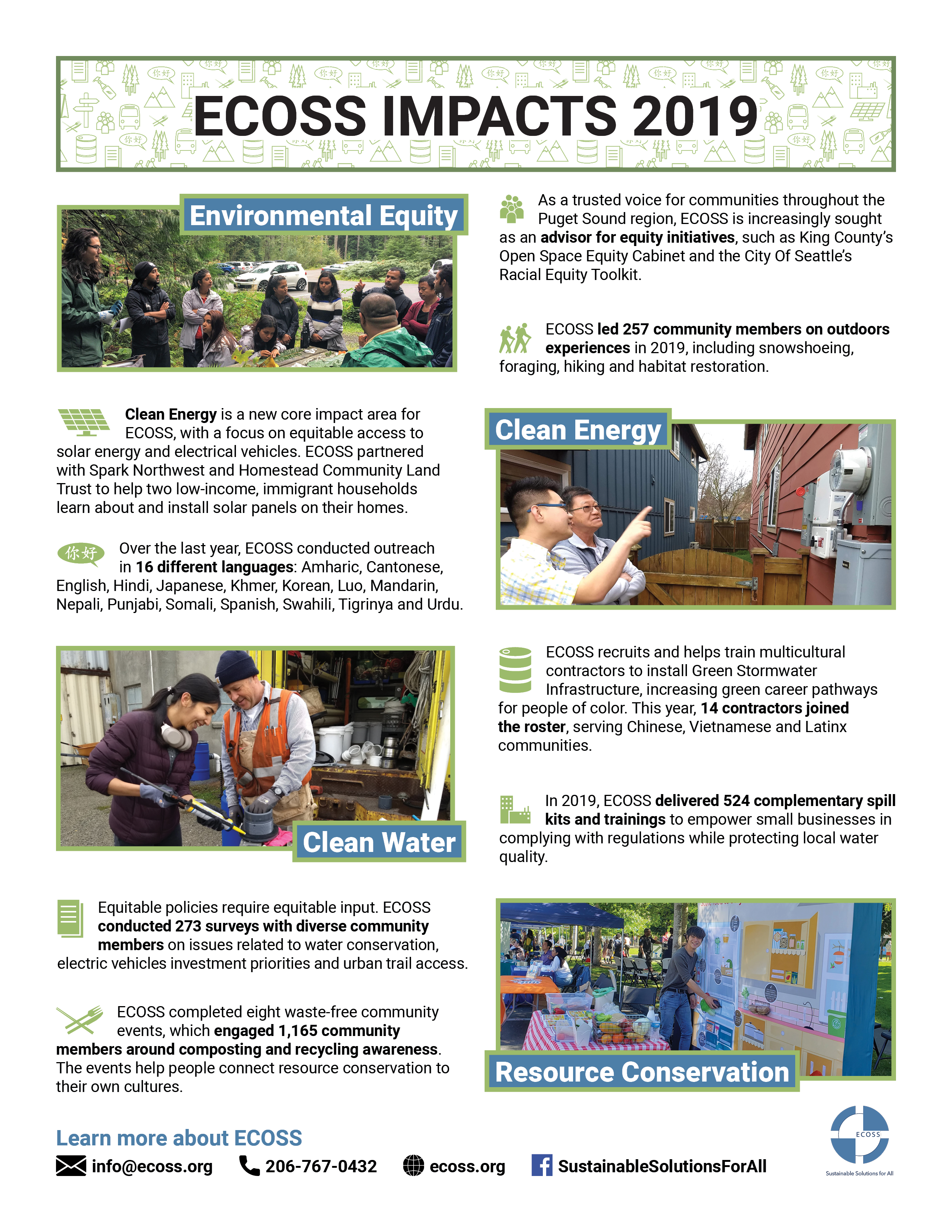
ECOSS’ 2019 Impacts

By building trust and relationships through shared language and cultural understanding, ECOSS empowers communities of color as environmental stewards, helps local businesses become more financially and environmentally sustainable, and advances the equity of environmental solutions.

2019 ushered in a new core program, new equity roles and more! Check out a summary of ECOSS’ impacts below:

Learn more about ECOSS programs here

ECOSS featured in Audubon Magazine!

“And I could see in their eyes, they were just taken aback. The kids were like: ‘What? In America, you can walk around in nature?’”

Multicultural Outreach Coordinator, Jabes Otieno, spoke to Audubon Magazine about his experience bringing members of African immigrant communities to nearby hiking trails. For many, this was a new and positive experience!

Check out the article here

This and other adventures were part of ECOSS’ multicultural outreach around the Trailhead Direct bus service. Working with The Wilderness Society, King County Parks and other partners, ECOSS is helping to lower the barrier to green spaces and the outdoors.

Read more about ECOSS’ Trailhead Direct outreach

Lowering barriers and inspiring outdoors enthusiasts

Being outdoors and around green spaces has been repeatedly shown to be good for one’s health. But not everyone has equal access to outdoor recreation opportunities. Trailhead Direct – a bus service provided by King County – lowers one of the greatest barriers to outdoor recreation: transportation.

In 2018, ECOSS partnered with King County Parks and The Wilderness Society to amplify the impact of Trailhead Direct through outreach to multicultural communities. By organizing and leading hiking trips with diverse communities, ECOSS created culturally-centered opportunities for community members to enjoy the outdoors and opened an avenue for immigrants, refugees and other people of color to give direct feedback on the bus service. This feedback contributed greatly to the opening of a Tukwila/Renton to Cougar Mountain route to meet the needs of South Seattle residents.

For the 2019 season, ECOSS reached 621 community members of diverse communities to raise awareness of Trailhead Direct. From that outreach, 145 people participated in ECOSS-led hikes! Youth, adults and seniors alike enjoyed the mountains, from strolls through Cougar Mountain to summiting the locally-famous Mailbox Peak.

Despite King County’s increased effort to advertise Trailhead Direct on common public transit options, most community hikers had never heard of the service. 76% of community hikers did not know about Trailhead Direct before ECOSS’ outreach. Many that did know were through previous ECOSS outreach. This was also reflected in communities’ feedback to King County.


“Let more people know about the services because I didn’t know we have this service until I went on this trip.” – Vietnamese community hiker

“Get information to minority communities.” – East African community hiker

This represents yet untapped potential for public transit to connect people and nature. Many community hikers with ECOSS were not just using Trailhead Direct for the first time, but also hiking for the first time. Community members cited barriers to participation such as knowledge of trails and knowledge of transportation options (especially for those without cars). But after overcoming those barriers, the benefits are vast, not just to health, but also to perspective:

“I participated for the first time in a hiking activity organized by Trailhead Direct and ECOSS last summer.  As a Latino immigrant man, I never had anyone to introduce me or invite me to explore this wonderful physical, social and emotional activity. Meeting new people in such a healthy outdoor environment and being able to reach extraordinary views and be in direct contact with the abundant nature of PNW was profound to me. I cannot wait to continue this activity with friends and other members of my community. Thank you so much to the organizers, sponsors and to the public transportation system for letting me have this positive experience free of cost.” – J. Fernando Luna, Latinx community hiker

One hiking trip centered on a group of 34 Latinx community members that included all ages! Photo Credit: ECOSS.

Lack of knowledge should not be misinterpreted as lack of interest. When presented in a culturally-relevant manner and with thoughtful inclusion, immigrants, refugees and other people of color are eager to engage in nature. As Trailhead Direct evolves out of its pilot phase, ECOSS is ensuring community feedback on the diverse needs in outdoor recreation reaches government so they can adjust accordingly. This type of private-public partnerships is promoting the vision of outdoors access and sustainable living for all.


Read more Trailhead Direct stories!

Thank you to The Wilderness Society and King County Parks for funding multicultural community engagement. Thank you Entre Hermanos and Bhutanese Community Resource Center for working with ECOSS to recruit hikers. Thank you REI, Mountains to Sound Greenway Trust and Washington Trails Association for your support.

Forging a path to foraging

Are you familiar with the Pacific Northwest’s variety of edible wild plants? The rainy climate that gives Seattle its gloomy reputation also feeds local mushrooms, ferns and other forage food. And this last autumn, ECOSS and Mountains to Sound Greenway Trust (MTS) opened up that world for one Bhutanese community.

In an immersive workshop along the middle fork of the Snoqualmie River, Bhutanese community members get a hands-on introduction to public land regulations and foraging. Photo Credit: Britt Lê / Washington Trails Association.

For Bhutanese refugees living in the greater Seattle area, there are several similarities between the forests of the Pacific Northwest and the jungles of Bhutan. This includes some shared wild plants such as the fiddlehead fern. But whereas Bhutan has few regulations on outdoors recreation, federal, state and county regulations restrict how people in the Pacific Northwest can use public lands and harvest plants.

Seeing the knowledge gap that prevented Bhutanese refugees from connecting with nature in the same way they would have in their native country, ECOSS worked with the community and with MTS to design an immersive workshop on public lands regulations and local foraging.

In an immersive workshop along the middle fork of the Snoqualmie River, Bhutanese community members get a hands-on introduction to public land regulations and foraging. Photo Credit: Britt Lê / Washington Trails Association.

The workshop included a guided walk/hike led by MTS and the US Forest Service, an introduction to the rules and regulations regarding public lands and a discussion of the different types of public lands. As a demonstration of the education, the workshop led into a conversation about foraging and local flora. After the formal workshop, the dozen Bhutanese community members were free to enjoy the surroundings and camp overnight.


“I am really thankful to this workshop. Foraging specially fiddlehead fern, watercress and mushroom was very common in our community back in Bhutan and in the refugee camp, but because of limited English and cultural differences, many of our community folks are not able to do what they loved doing.” — Bhutanese community member, workshop attendee

ECOSS’ New Arrivals program collaborates with communities of color to create access to environmental education and experiences that are directed by community needs. This community-centric approach ensures both program success and community benefit, like in this public lands workshop.

Read more New Arrivals stories

Thank you Mountains to Sound Greenway Trust for partnering with us, Washington Trails Association for providing gear, US Forest Service for providing public lands education and Bhutanese Community Resource Center for bringing community members!

First Trailhead Direct trip of the season in the books!

Find yourself wanting to escape the city on weekends? Do you enjoy hiking? King County’s Trailhead Direct bus service offers a solution for accessing trails near the Greater Seattle Area and is in its third season of operation.

ECOSS partnered with King County Parks and The Wilderness Society last summer to conduct outreach on Trailhead Direct within communities of color. By leading trips with the Khmer, Bhutanese, Latinx and Korean communities, ECOSS helped build the case to expand Trailhead Direct services, which added stops in Tukwila and Renton this season.

Continuing the momentum, ECOSS is working with Chinese, Vietnamese, Latinx, Bhutanese and East African communities to access Trailhead Direct and nearby trailheads this summer.

Members of Hong Kong, Chinese and other Cantonese-speaking communities recently completed their trip to Issaquah Alps! Check out some photos from the trip:

Most of the Cantonese-speaking participants had not heard of Trailhead Direct before the ECOSS trip, despite being avid hikers. The cloudy morning skies gave way to lush greens as the group embarked up Margaret’s Way Trail. The hikers appreciated the fresh air and ample trees. They even encountered a garter snake on the way up.

Most Trailhead Direct bus stops feature this sign. Unfortunately, it is often missed by those who are unfamiliar. Photo Credit: Joycelyn Chui / ECOSS.

The trip was also an opportunity for diverse feedback. Finding the initial bus stop was a challenge with minimal Trailhead Direct signage at the Eastgate Park and Ride station. Combined with a premature bus departure, the group was forced to catch the following bus… which was practically full before the group of 17 could board.

Undaunted, the group ultimately made their way to the top of the Margaret’s Way Trail. Many commented that they would recommend Trailhead Direct to others despite the challenges they faced.

By now, many King County residents have heard about Trailhead Direct, especially those who regularly take public transit. But the banners, brochures and advertisements don’t naturally reach all residents. Non-English speakers and those who live farther away from transit corridors are much less likely to be exposed to Trailhead Direct.

Access to green spaces promotes individual health and community connections. ECOSS is dedicated to ensuring outdoors access extends to communities of color as well.

More stories on outdoors access here!

A day of sparkling waters and shared reflection

Cedar River waterfall

A waterfall stills hikers with its magical light show. Photo Credit: Zacke Feller.

Written by Uroosa Fatima, Multicultural Outreach Manager

Living in Seattle, I find it hard not to think about water. Whether it’s twinkling at me from across the bridge or attacking me from the sky, water finds a way to get noticed every day. Surrounded by all these glamorous bodies, I sometimes overlook the city’s best water feature: tap water. A fresh, cool stream that flows reliably whenever we need it.

But why does the tap water here taste so good? The greater Seattle area gets its water supply from two systems, the South Fork Tolt River watershed and the much bigger Cedar River Municipal Watershed. Both of these regions are heavily protected areas and allow minimal access to humans. The watersheds are kept as pristine as possible, so the water requires minimal treatment. Additionally, Seattle is unique among urban American cities for not repeatedly recycling its tap water, which elsewhere leads to flat-tasting water.

Watershed model

Rangers teach the group about the watershed using a model of the region. Photo Credit: Zacke Feller.

Recently, I got the chance to go see the Cedar River Municipal Watershed on a hike organized by ECOSS in partnership with Seattle Public Utilities (SPU). The aim of this hike was to introduce some of Seattle’s newer communities to the watershed that feeds their drinking supply. The diverse group included members from the Vietnamese, Chinese, East African and Pakistani communities.

After meeting with the park rangers at Cedar River Educational Center and learning the rules of conduct, the hikers were driven up to the restricted municipal watershed. The watershed is divided into two basins, the larger Chester Morse Lake and the smaller Masonry Pool, which was created as a result of the Masonry Dam. Following the guides the group walked along parts of the dam and saw how the structure is used to generate electricity and regulate water flow.

We stopped over the dam to see how it was used to regulate water, and to take lots of pictures! Photo Credit: Zacke Feller.

During their trip, hikers learned more about the function, history and ecology of the watershed from the rangers guiding the excursion. 1.4 million people in the region, and countless iconic species like the Northern spotted owl, Chinook salmon and Grizzly bear depend on this basin for a constant and pristine supply of water. This led to lively discussions among the group and the guides facilitated by multilingual ECOSS coordinators on topics like long term regional season patterns, drought conditions, and the historic importance of the watershed to native tribes.

A lively discussion about the history, cultural importance and value of the watershed. Photo Credit: Zacke Feller.

At the end of the hike, the hungry group returned to the Educational Center for some Banh Mi sandwiches and rest. Many felt that the experience gave them a deeper understanding of where their drinking water comes from and what it takes to keep it clean.


Read about other work with New Arrivals!

Thank you Seattle Public Utilities for working with ECOSS to make this insightful trip possible!