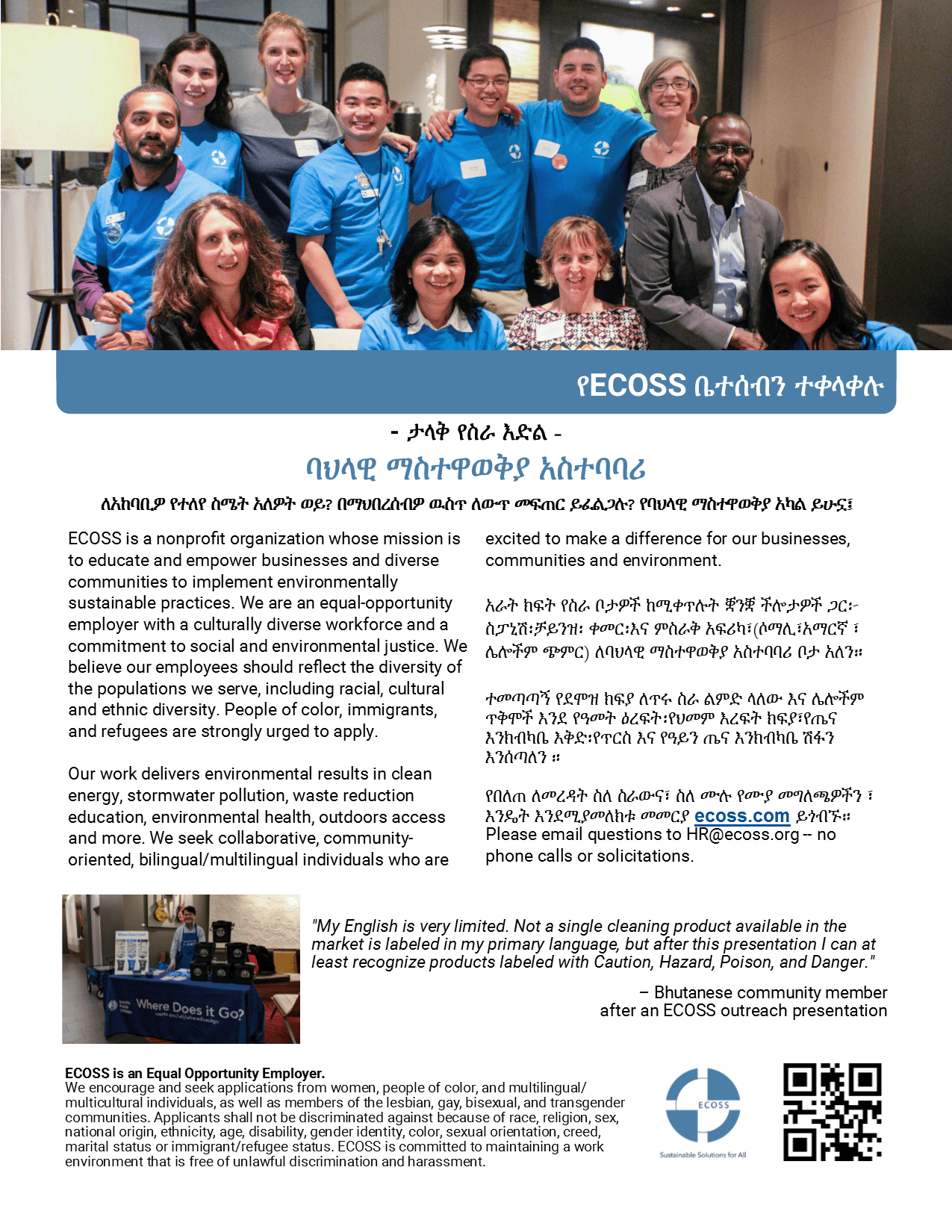
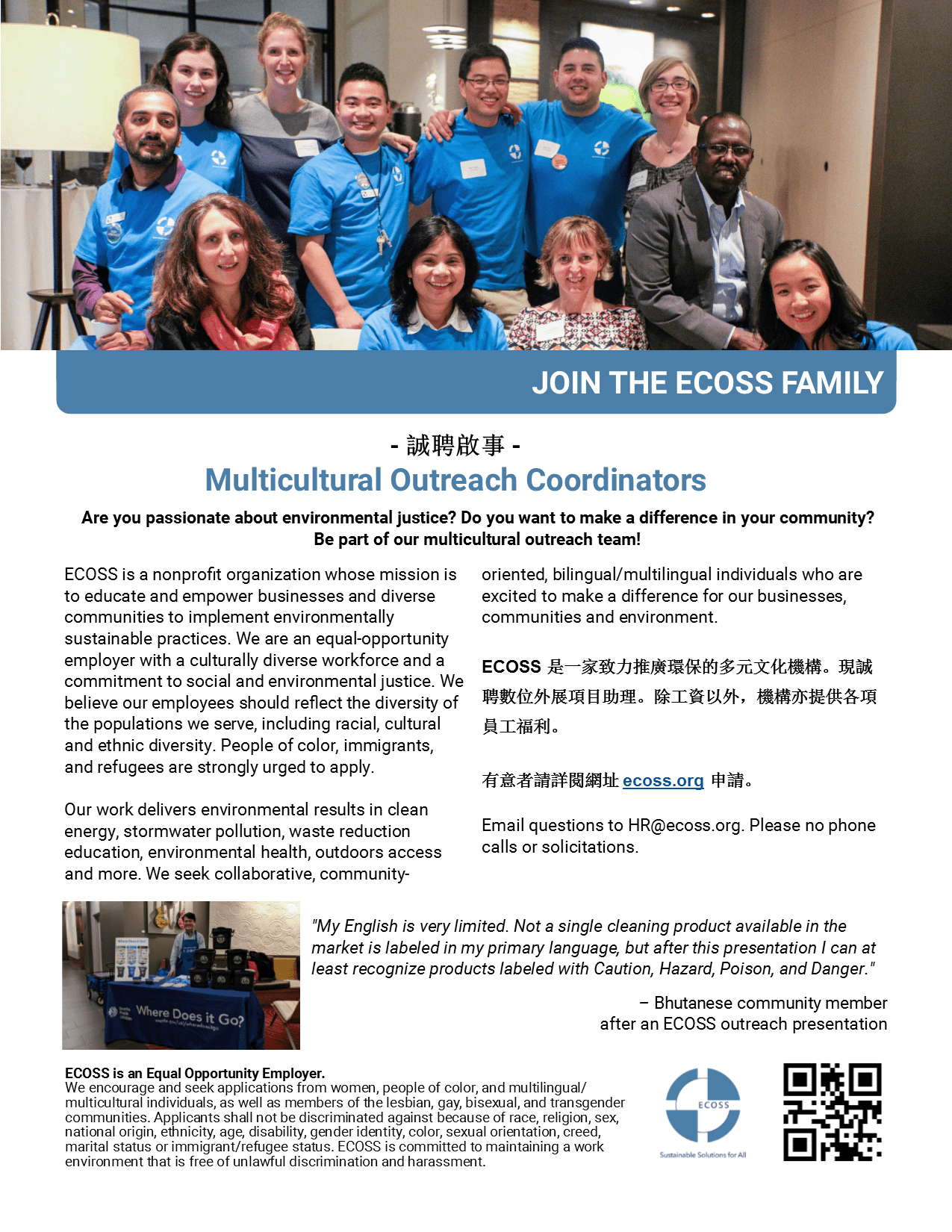
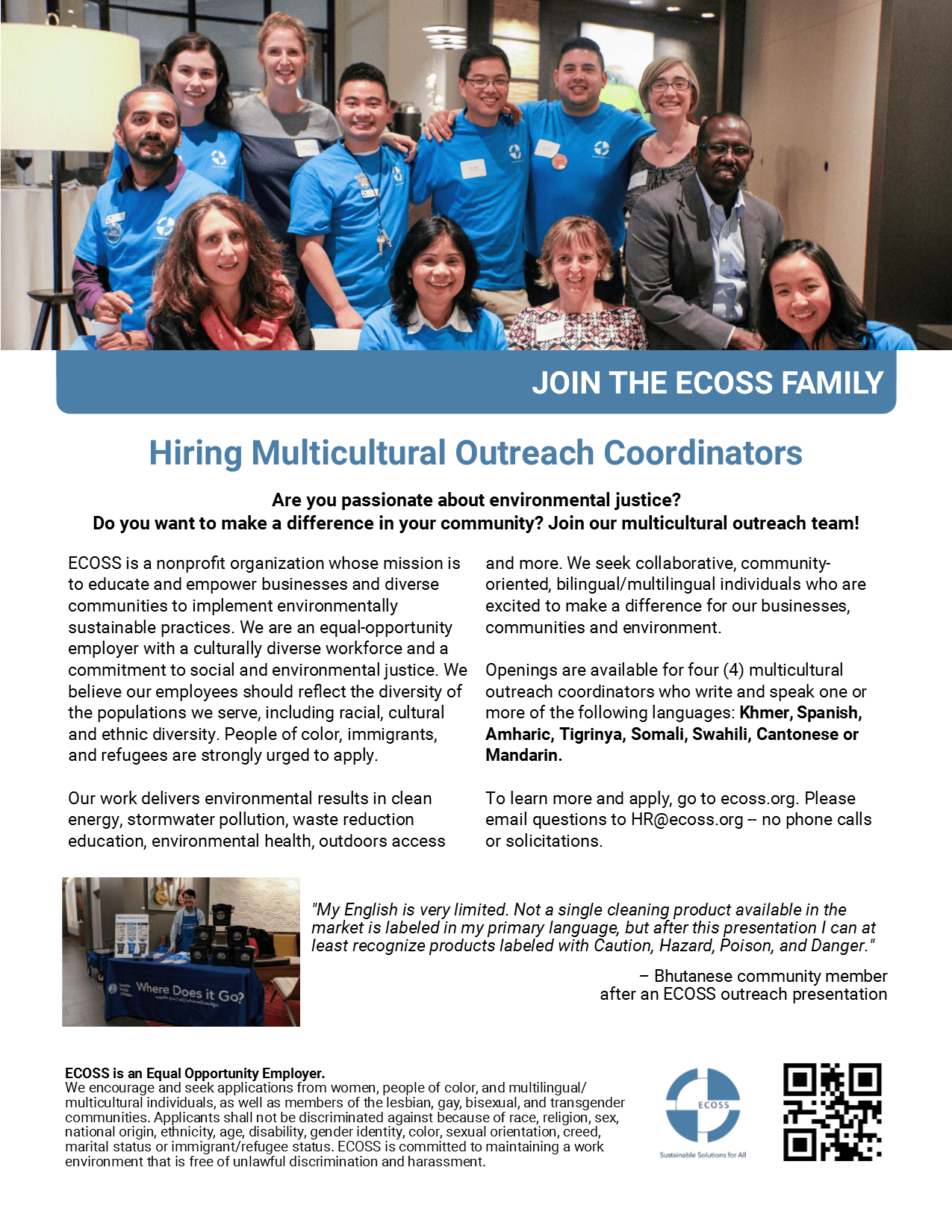
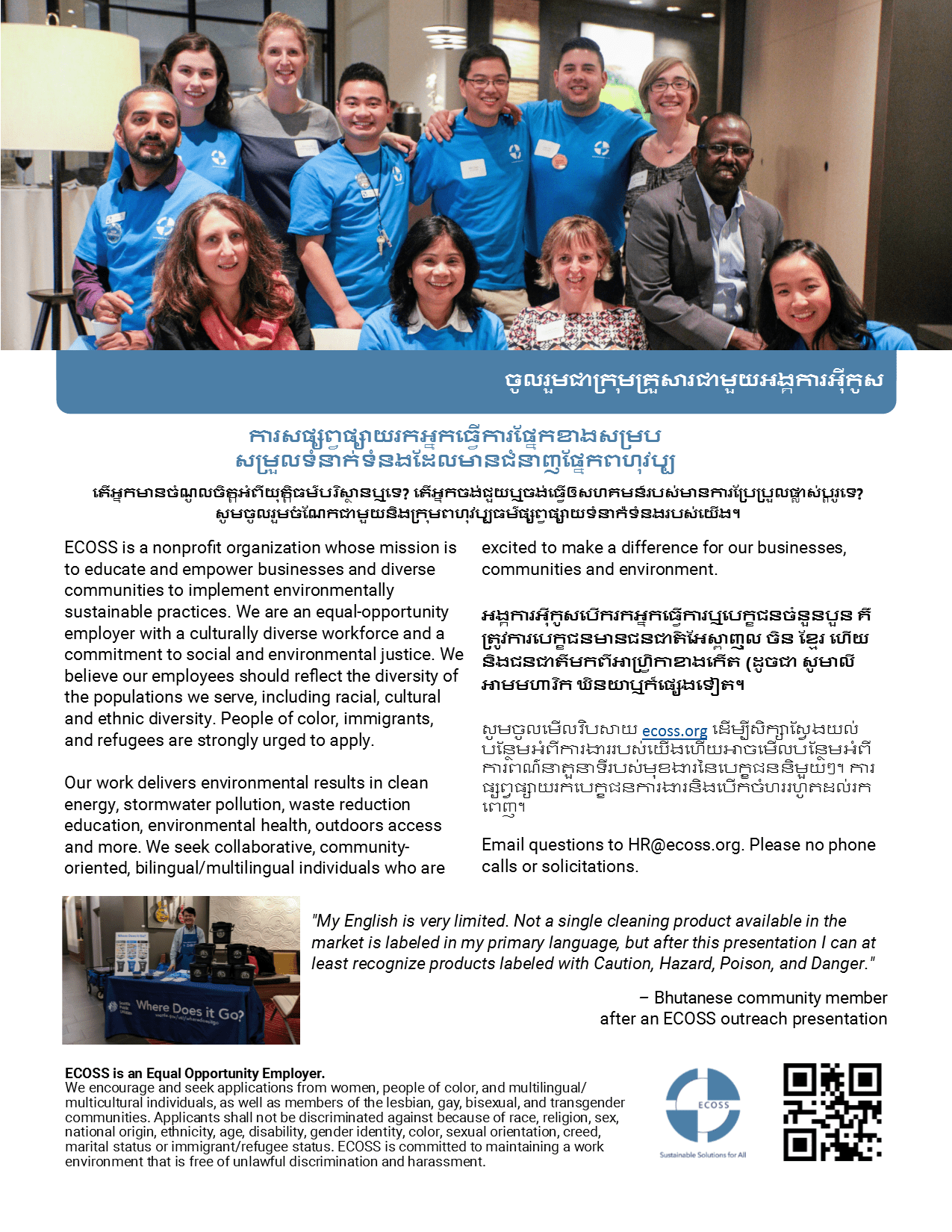
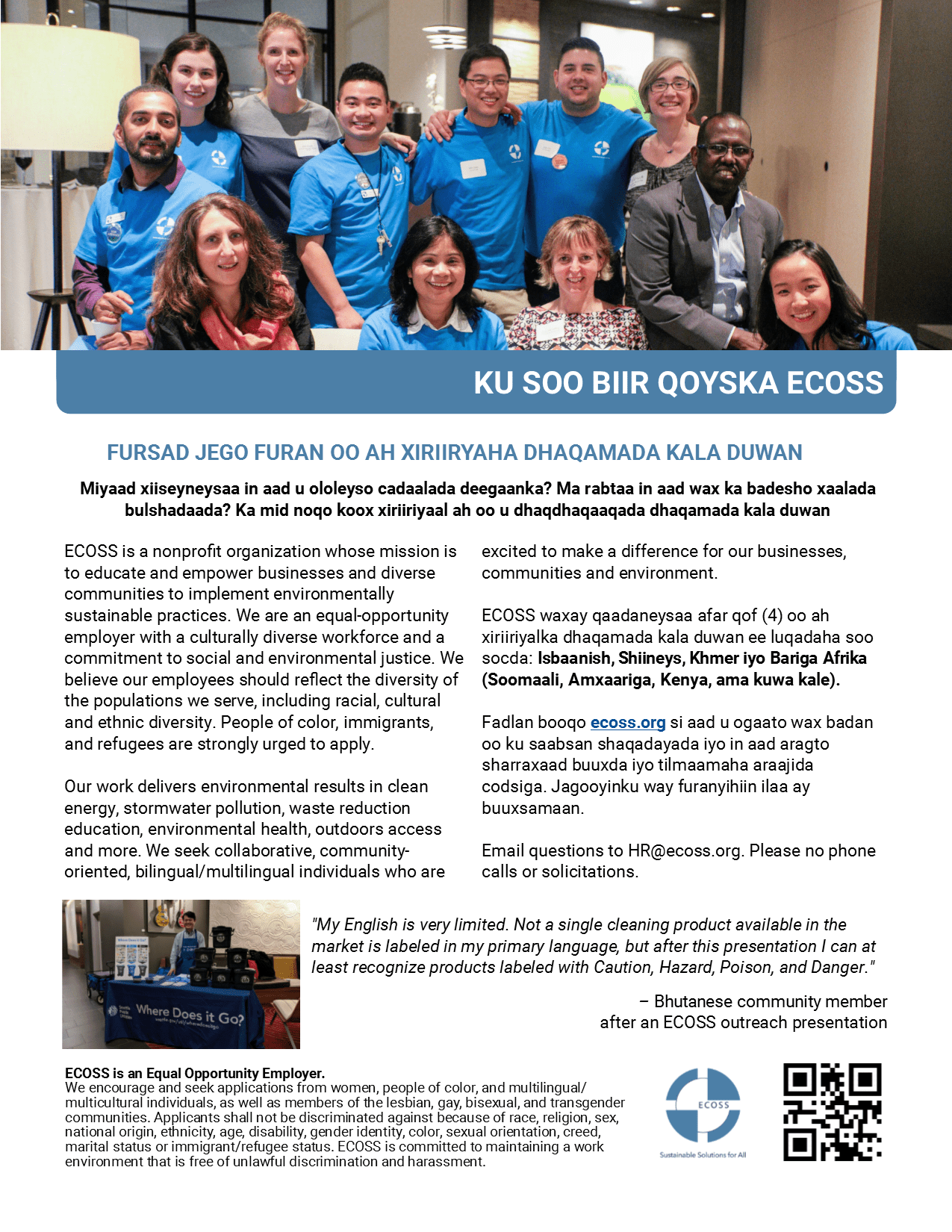
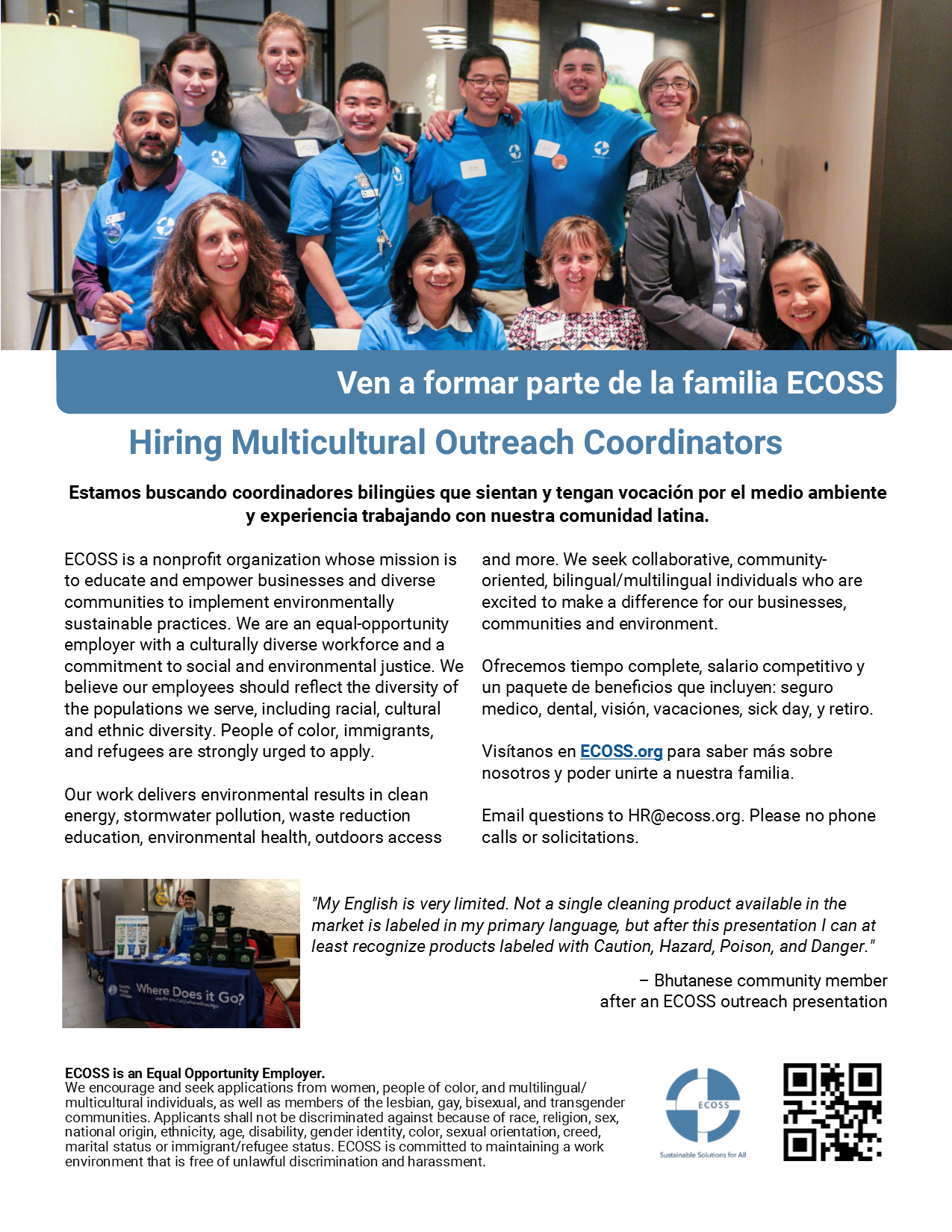
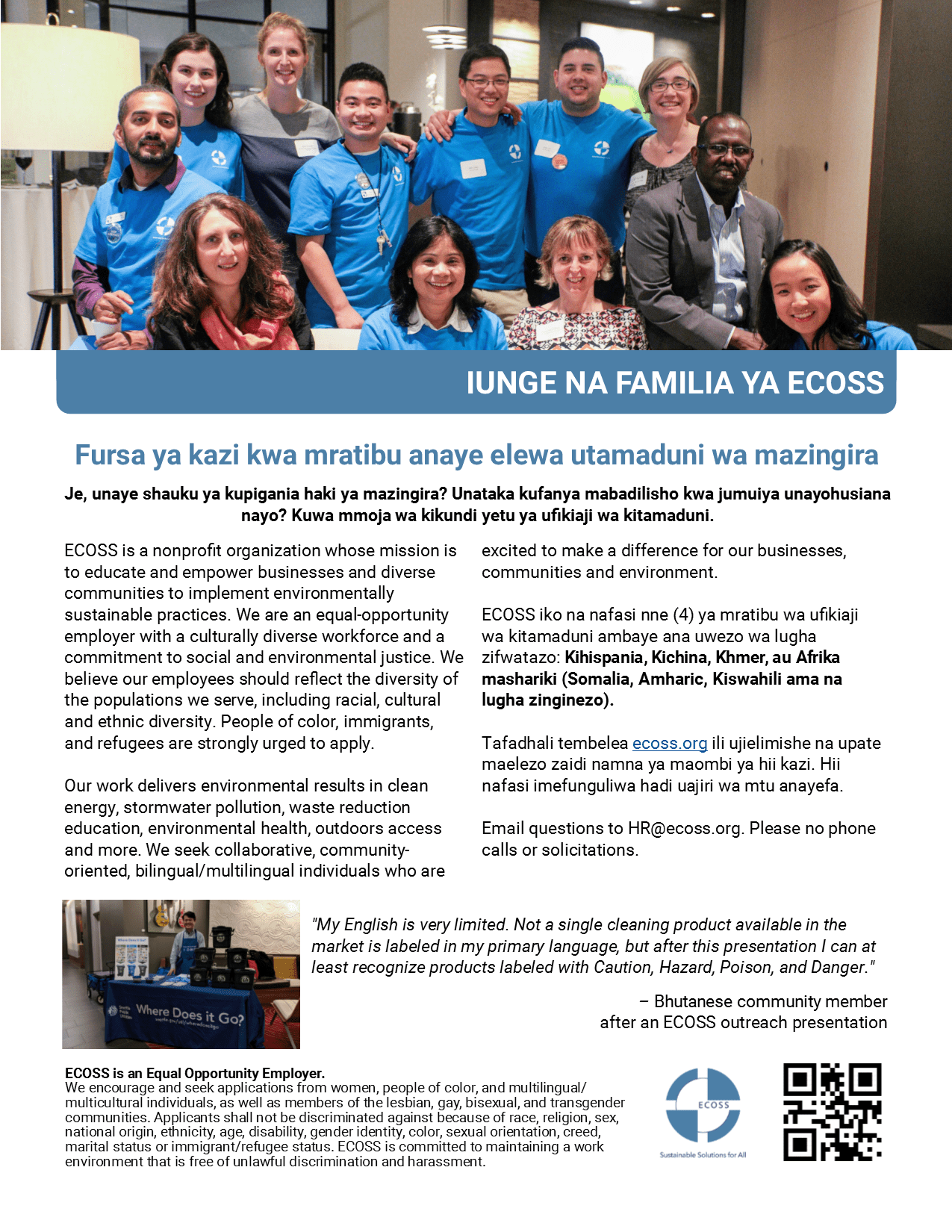
We’re hiring! Join our multicultural outreach team

Are you passionate about environmental justice? Do you want to make a difference in your community? Join our multicultural outreach team!

ECOSS empowers diverse businesses and communities to become more environmentally resilient and sustainable. In 2018, we conducted outreach in a dozen languages covering topics ranging across clean energy, stormwater pollution, waste management and more.

The key to our approach is hiring from within the communities that we serve. Our outreach staff understand the communities’ cultures and needs because they are part of those communities. We are expanding this team so that all communities can thrive and be environmentally sustainable.

Are you a bilingual/multilingual individual who would be excited to promote environmental justice with our Chinese, Latinx, Khmer and/or East African communities? Apply to join our multicultural outreach team!

Go here to read the full job description and application instructions


Over 10,000 businesses and community members served in 2018

“My English is very limited. Not a single cleaning product available in the market is labeled in my primary language, but after this presentation I can at least recognize products labeled with Caution, Hazard, Poison, and Danger.”

The passing of a calendar year is often a time for reflection and celebration. With the recent transition into a Gregorian New Year along with Lunar New Years celebrations starting on February 5 (Chinese New Year, Tết, Seollal, Losar, Tsagaan Sar), now is the perfect time to reflect on ECOSS’ impacts for sustainable businesses and diverse communities in 2018:

But outreach and community engagement is not just about numbers. We empower sustainable businesses and communities of color to improve the lives of people. Feedback from businesses, communities and partners is critical for improving the education and services we provide.

We served over 10,000 businesses and community members in 2018. And 2019 looks to be even more impactful. New Arrivals is expanding to more communities. Waste management outreach is shifting from simply recycling and composting conversations to education around food waste reduction. And our RainWise outreach continues to grow in ambition. Look forward to the stories in 2019!

Learn more about our projects

Want to learn more about the individual successes that contributed to these impacts? Check out the links below:

Want to help us continue this impactful outreach and education? Give a gift for sustainable businesses and diverse communities.

Multicultural outreach extends green outdoor access to diverse communities

“ECOSS’ ambassador model and community-based work is invaluable and irreplaceable. Their successful outreach is a major achievement of the Trailhead Direct program.” — Mountains to Sound Greenway Trust

Bhutanese community used the Trailhead Direct service to travel to Mt. Si. Photo Credit: Allan Kafley, ECOSS.

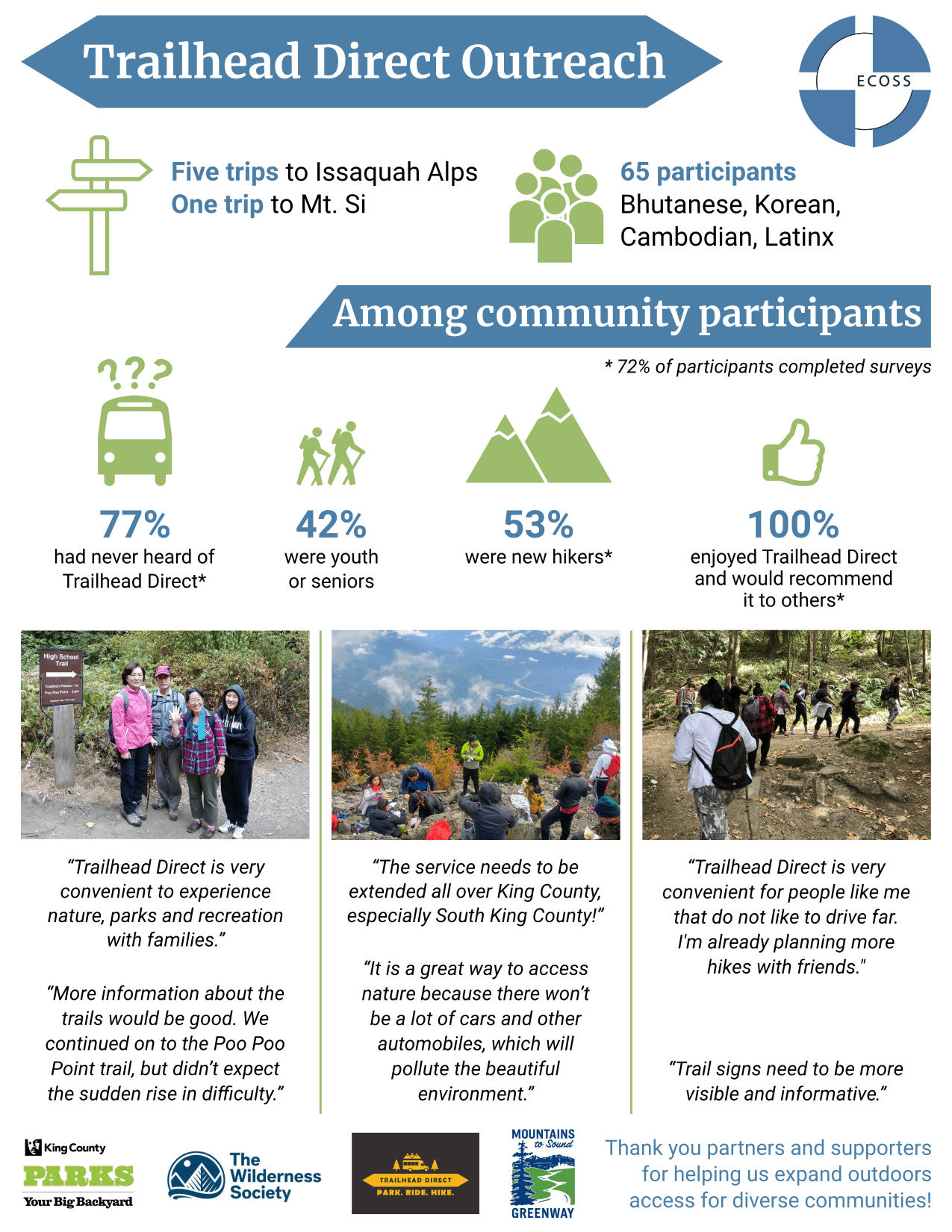
Over the summer and autumn of 2018, ECOSS led 65 hikers from diverse communities on hikes throughout Washington! For numerous hikers, these trips were only possible thanks to Trailhead Direct, a service launched by King County Parks and King County Metro.

Many immigrant and refugee communities around Puget Sound yearn for opportunities to connect with nature, but face language, cultural and lifestyle barriers to accessing the outdoors. Transportation access is one of the greatest of these barriers.

“Trailhead Direct is a great way to protect our environment by not driving personal cars.” — Bhutanese community member.

King County’s Trailhead Direct service seeks to lower the transportation barrier by providing an affordable alternative to driving to faraway hiking destinations. At the same price point as any other bus ride in the city, a Trailhead Direct bus will drop you off and pick you up at trailheads at Issaquah Alps, Mt. Si and Mailbox Peak. And by partnering with ECOSS, Trailhead Direct reached communities in 2018 that would otherwise have never heard of this transportation option.

Trailhead Direct enabled the Cambodian community to bring all family members hiking, from youth to seniors. Photo Credit: Sophorn Sim / ECOSS.

To help King County learn about the accessibility of Trailhead Direct and improve the service, ECOSS led hiking trips via Trailhead Direct with members of the Bhutanese, Cambodian, Korean and Latinx communities. In partnership with King County Parks and The Wilderness Society, we also developed surveys that gauged participants’ outdoors experience and solicited feedback on the Trailhead Direct trips.

During our outreach, 53% of hikers were new to the activity and 42% were youth or seniors. And regardless of age or experience, all hikers enjoyed Trailhead Direct and would recommend it to others. Check out our infographic summarizing the season’s outreach for other statistics and feedback from communities!

ECOSS’ New Arrivals program connects immigrants and refugees with environmental education and outdoor experiences that align with their interests. We look forward to continuing partnerships to ensure diverse communities can take advantage of Trailhead Direct service.

Check out other New Arrivals activities

Thank you to King County Parks and The Wilderness Society for your generous funding and support. And thank you to Mountains to Sound Greenway Trust for connecting us to the opportunity to conduct this outreach. We’re proud to lower the transportation barrier to the outdoors and enable connections to nature for all.

November 27 is #GivingTuesday

Give today to promote environmental solutions in local communities and your gift will be doubled for #GivingTuesday!

Multicultural Outreach Associate digging into his work, helping build a rain garden at Sylvester Middle School. Photo Credit: Leda Costa.

Your donation will fund projects like our RainWise outreach, tackling Puget Sound’s #1 source of pollution: stormwater. 2018 marks the addition of over 200,000 gallons per year in stormwater management from RainWise demonstration site installations.

Promote environmental sustainability

Kevin Duong, Multicultural Outreach Associate, explains how this program is essential:

“This year, the RainWise outreach team completed our first collaboration with a restaurant. Young’s Restaurant joins other important demonstration sites like Co Lam Temple and Pyung An Presbyterian Church to educate diverse communities about stormwater pollution and what they can do at home, like installing rain gardens and cisterns.

At Young’s Restaurant, I had the pleasure to work with Janice, Ella and Mr. Van Young, who are all so happy about their three giant cisterns. The collected rainwater waters their mini vegetable garden while preventing flooding during the rainy season. They really appreciate the RainWise program, which helped install the three cisterns.”

Donate today

New Arrivals program is a featured social innovation

Bhutanese hiking trip to Mt. Si. Photo Credit: ECOSS.

Many immigrants and refugees appreciate the environment and want to protect nature, but are unaware of opportunities to do so in new surroundings. The New Arrivals program connects these new Seattle residents to environmental education, outdoor opportunities and more.

Read about how and why the New Arrivals program focuses on multicultural outreach in this feature with the Social Innovations Journal!

Learn more about New Arrivals

The New Arrivals program is generously supported by the Satterberg Foundation, the Rose Foundation and the Cuyamaca Foundation.

Multicultural business outreach the focus of City Habitats story

Young’s family standing in front of their restaurant’s cisterns. Photo Credit: Sam Le.

Equitable access to environmental solutions means reaching out to underserved communities. These are often the people most impacted by water pollution, air pollution and other environmental challenges, yet commonly face language and cultural barriers that hinder their ability to protect the environment.

In partnership with King County’s RainWise program, ECOSS helped Young’s Restaurant become the first Seattle restaurant and business to be part of the stormwater pollution solution. And The Nature Conservancy’s City Habitats program recently featured this accomplishment!

ECOSS recruited multicultural contractors for this project and helped both the contractors and restaurant owners navigate the RainWise program to install and maintain cisterns at Young’s Restaurant.

Learn more about our RainWise work

Young’s Restaurant featured in NW Asian Weekly

The Young family cutting the ribbon to commemorate the first restaurant-owned cisterns in Seattle. Photo credit: Sam Le.

Read the NW Asian Weekly article!

Young’s Restaurant recently commemorated their cisterns with ECOSS and King County RainWise. They are the first Seattle restaurant and business to install green stormwater infrastructure — sustainable solutions that help mitigate stormwater pollution. This success story was possible due to multicultural support from ECOSS and an effective partnership with King County. Young’s is protecting Puget Sound waters by decreasing the risk of combined sewer overflows while storing water for tending their gardens. Read more about them in this Northwest Asian Weekly article.

Check out more RainWise stories!

Doris Duke Scholars engage underserved communities around environmental sustainability

Dedication. Passion. Determination. Resilience. Pride. The Doris Duke Conservation Scholars exuded these feelings and many others during the Conservation Scholar Summit, where individuals shared connections with their communities, cultures and environment. Most significantly, they planted their banners of belonging to the environmental movement — a fitting conclusion to the scholars’ summer.

Doris Duke Scholars MaKail Crawford (2nd from left) and Pheng Lor (far right) at the Conservation Scholar Summit. Photo Credit: Joycelyn Chui / ECOSS.

ECOSS was fortunate to host two Doris Duke scholars this summer: Pheng Lor, a UC Berkeley student focusing on conservation and LGBT studies, and MaKail Crawford, hailing from Wesleyan University working on classics and Latino studies.

MaKail and Pheng dove into a variety of outreach activities, from conducting house visits for rain gardens to helping with a multicultural celebration of water.

Their work culminated in final projects that engaged the Seattle Hmong and Latino communities. Pheng designed a survey and attended Hmong community events to gather their environmental concerns. MaKail trans-created a Spanish brochure to promote Trailhead Direct, a King County project providing bus routes to nearby outdoor recreation opportunities. Each laid the foundation for strong connections and community partnerships.

After far too short a time, we had to say farewell to our scholars as they returned to their home universities to finish their undergraduate studies. In typical ECOSS tradition, we celebrated their time here over good food.

As the scholars finished up, Pheng Lor reflected on his time with ECOSS:

“My internship with ECOSS has provided me a foundation for working with environmental nonprofit organizations. As expected coming into the internship, the community services that ECOSS provides to underserved communities to encourage environmental sustainability and to bridge environmental awareness and education is both inspiring and humbling.

One of my biggest takeaways is the commitment ECOSS staff has to community, particularly to communities of color. As a Hmong scholar and community organizer, I had the honor of experiencing ECOSS staff extensively reach out to the Southeast Asian community, a community that in countless fields is often neglected. This meant the world to me. Seeing that the staff represents most of the communities they serve — that’s environmental equity in practice. ECOSS’ values are what I believe today’s environmental progress and work should embody and their staff represents nothing less than their efforts towards the most effective and inclusive future, ensuring every community has access to environmental knowledge and engagement. From this takeaway I’ve also learned that the environmental work ECOSS does isn’t anything near easy and it isn’t for everyone; I am glad to have had the privilege in challenging myself in many capacities as an ECOSS intern.” 

Read about our 2017 Doris Duke scholars

Thank you to Pheng Lor and MaKail Crawford for promoting environmental sustainability, equity and justice in Seattle! And thank you to the Doris Duke Conservation Scholar Program for providing us with our scholars! We look forward to seeing you and the rest of the Doris Duke Conservation Scholars grow into the forces for change that underserved communities need.

Learn more about multicultural outreach!

Congratulations to the Community Health Advocates!

For some, this was the first graduation ceremony they had ever attended. The excitement was palpable. But this was no regular graduation ceremony.

This was the graduation of some of the most creative members of Seattle’s Latino/a, Vietnamese and Khmer communities, celebrating their completion of training to become Community Health Advocates. Over the previous few months, ECOSS facilitated training about local environmental health risks and helped the advocates practice their outreach to communicate these risks to their communities. This is in partnership with King County Public Health under the auspices of the Environmental Protection Agency.

Group photo of all Community Health Advocates and facilitators. Photo Credit: Hannah Letinich.

Raising awareness about environmental health requires actively engaging community members. This means doing away with word-dense information packets. Instead, community leaders instill their culture into the outreach lessons.

And the graduation ceremony would not be complete without the same level of creativity! Though there were inspirational, heartfelt graduation speeches aplenty, the Community Health Advocates and facilitators also strengthened their relationships with team building activity, such as an interactive string game.

Interactive string game. Photo Credit: Hannah Letinich.

Ultimately, this project is not just about training health advocates; it is also about helping community members become community leaders. Advocates are empowered to be the voice for their communities in engaging public agencies, and they build skills that will benefit future career paths.

After graduation, these community health advocates are raising awareness and engaging their communities about the contamination issues of the Duwamish River and about healthy seafood choices. We look forward to seeing their creativity in promoting environmental health for all!

The Community Health Advocates program is part of Seattle and King County’s Public Health department, which is funded through EPA as part of the Fun to Catch, Toxic to Eat Program for the Lower Duwamish Waterway Superfund Site.

Electric Vehicles Outreach is an Energizing Endeavor!

Nearly 300 individuals representing ten communities, speaking eight different languages, of all ages from children to seniors. This was the extent of our outreach on electric vehicles in the last two months!

The City of Seattle has set the goal of becoming carbon neutral by 2050. And changing the way we as a city get from point A to point B is central to reaching that goal. Transportation is the single greatest source of carbon emissions in Seattle, almost doubling the emissions of buildings – the next largest carbon emission sector.

Clean energy solutions such as electric cars offer significant opportunities to reduce carbon emissions and improve air quality. But although underserved communities such as ones of immigrants, refugees and other people of color are disproportionately impacted by issues such as air pollution, climate solutions tend to reach these communities the least. This is why Seattle’s strategy for electrifying the city’s transportation includes a lens on racial and social justice.

We teamed up with Forth Mobility to engage diverse communities around the prospect of electric vehicles. Photo credit: Sam Le.

Thus, we were excited to partner with Forth to conduct multicultural outreach on electrical vehicles in neighborhoods around South Seattle. This included focus groups, listening sessions and surveys with Somali, Latino/a, Ethiopian, Vietnamese and other communities where residents could voice their needs and concerns about electric vehicles and transportation access in general. Our outreach culminated in two Electric Car 101 public listening sessions where we answered questions and concerns for the broader community and brought electric vehicles for community members to explore.


We provided electric cars at our information sessions for hands-on exploration. Photo credit: Sam Le.

Top transportation concerns included increasing traffic, public transit access and the cost of gas while top electric vehicle concerns included their affordability as well as uncertainty around charging cars and driving range. Nevertheless, interviewees overwhelmingly wished to see more electric vehicles in their community, citing that they were good for the environment and avoided air pollution.

Associate Jose Chi engaging a community member at an information session for El Centro de la Raza. Photo Credit: Sam Le.

These communities care about the environment and support climate change solutions. But they also face additional challenges in rising costs of living, gentrification and social exclusion. The rise of electric vehicles could push underserved communities out. But by including diverse communities in the conversation and implementation around clean energy, we can all promote a cleaner, more equitable Seattle together.

Learn more about our clean energy outreach