ECOSS has been working with communities to restore a habitat site at Seward Park. The site was previously covered in Himalayan Blackberries, which are a non-native species that out-competes understory vegetation and makes it difficult for trees to grow due to the thick foliage. According to kingcounty.gov, the Himalayan blackberry is a Class C noxious weed. Although control of Himalayan Blackberry is not required, it is recommended in protected wilderness areas and in natural lands that are being restored to native vegetation because of the invasiveness of these species.
Last summer, ECOSS invited immigrant, refugee, and BIPOC communities to come together for a work party to restore the land and clear out Himalayan Blackberries at a site in Seward. This month, 14 adults and 3 youths from the community came together with ECOSS and Mountains to Sound Greenway Trust for a planting event. The day included reflection on how we can form impactful connections to the land, forming new relationships with staff and community, and planting native trees and shrubs to restore the land. By the end of the event, about 135 native plants had been planted at the site. Community members were also invited to take a native plant with them to plant at home.
I was mindful when ordering the plants for this project– typically in restoration work there isn’t a lot of variety or diversity in the plants that are planted, so I took this opportunity to incorporate plants of importance that most people don’t typically see or work with. It affirms my passion to grow this impact area in our organization and to be able to provide more opportunities to our community to steward the land whether it’s in a leisurely setting or a skilled professional setting.
Miranda perez, Senior Program Manager
Here are 14 native species that ECOSS planted with the community at Seward Park
Compiled by Miranda Perez, ECOSS Senior Program Manager, with information from Plants of the Pacific Northwest by Jim Pojar and Andy MacKinnon.
Trees:
Red alder, alnus rubra—large deciduous; considered the best wood for smoking salmon and other fish and valued for its medicinal qualities in making a tonic for tuberculosis and respiratory ailments; improves disturbed soil by fixing atmospheric nitrogen into the soil
Cascara, rhamnus purshiana—tall shrub/small tree; the bark was boiled and drunk as a strong laxative tea by Nuxalk, Coast Salish, Quilete, Nuu-chah-nulth, Kwakwaka’wakw and other groups. It has been scientifically proven to be an effective laxative
Shore pine, pinuscontorta—large conifer; The Haida used peeled sheets of the bark as splints for broken limbs; Also used medicinally by Nuxalk, Coast Salish, Nuu-chah-nulth, Kwakwaka’wakw, Haida, Tsimshian, and Tlingit as gum, and applied to cuts as well as the skin to treat heart pain and rheumatism.
Western red cedar, thuja plicata—large conifer; Trees of life are held with high respect for their healing and spiritual powers by west coast peoples; cedars were extraordinarily useful to indigenous people of PNW and played key roles culturally, providing for the people from birth to death, cradles to coffins.
Shrubs:
Oregon grape, mahonia nervosa—yellow blooms; the tart berries were eaten (with great caution as they are very potent) in a mixture with salal berries or other sweet fruit, or medicinally for liver, gall bladder, and eye problems; the bark was used to make a bright yellow dye for basket materials
Twinberry, lonicera involucrate—yellow blooms; the blackberries are not considered edible and often considered taboo as the Kwakwaka’wakw believed eating them would cause one to become unable to speak; The Quileute and Kwakwaka’wakw used the berries as a black pigment, and the Haida rubbed the berries on their scalp to prevent grey hairs.
Salal, gaultheria shallon—white/pink blooms; the dark juicy berries were important to many groups eaten fresh and dried into cakes; young leaves were chewed as a hunger suppressant by the Ditidaht.
Herbs and Flowers:
Entire leaved gumweed, grindelia integrifolia—yellow bloom; important to many Coast Salish peoples, used medicinally to treat asthma, bronchitis, colic.; great pollinator plant
Goatsbeard, aruncus diocius—white blooms; the Tlingit and Makah prepared the root for curing diseases of the blood (commonly gonorrhea); the Lummi chewed the leaves to help cure smallpox; An infusion of the roots was given to Squamish women just before giving birth to help heal; other parts of the plant were steeped and bathed in to help with swelling.
Oregon sunshine, eriophyllum lanatum—yellow blooms; great pollinator plant
Pearly everlasting, anaphalis margaritacea—white blooms; Ditidaht healers rubbed this plant on their hands to soften them; the Nlaka’pamux used this plant in an influenza medicine.
Slender cinquefoil, potentilla gracilis—yellow blooms; used as a food by most coastal groups; patches of cinquefoil were traditionally owned by certain chiefs of Nuu-chah-nulth, Kwakwaka’wakw, and Haida; the roots were dug out by women in the late fall/early spring and were steamed to remove bitter flavor, once cooked they tasted similar to a sweet potato.
Grasses and Ferns:
Tufted hairgrass, deschampsia cespitosa—structure/host plant; grasses are important ecological structures since they provide necessary food, shelter, and life cycle completion for many animals and species; their root system aids in preventing erosion and flooding.
Lady fern, athyrium filix-femina—structure/host plant; similar to grasses they are important ecological structures; the leaves were used by coastal groups for covering food, laying out food, and drying berries on; the fiddleheads were eaten in early spring by boiling, baking, or raw with grease.
This Environmental Stewardship program is made possible by the support of Mountains to Sound Greenway Trust and Green Seattle Partnership.
ECOSS recently wrapped up its summer season of in-language hiking trips to Little Si, on Snoqualmie Ancestral Lands, through King County Metro and King County Parks’ Trailhead Direct program, with support from Washington Trails Association’s Outdoor Leadership Training. Part of ECOSS’ mission is to connect BIPOC, refugee, and immigrant communities with environmental solutions and stewardship opportunities. BIPOC communities have historically experienced barriers to recreation and outdoors access, such as language, transportation, safety, and general knowledge about hiking. ECOSS’ guided in-language hiking program utilizes KC Metro and KC Parks’ Trailhead Direct bus service to expand access for these communities. This year, over 66 community members of all ages and across 7 languages participated.
For many of the community members, aged 4 years old to 50+, this was their first experience in hiking, exploring, and learning how to express themselves in nature. ECOSS’ program created an opportunity to engage with Seattle’s public transportation system and a popular hiking trail in a way that felt accessible and comfortable, especially with in-language support available to coordinate logistics and answer questions. The trip leaders each received training from WTA to further support their community members on the trail and teach them about different aspects of safe outdoor recreation.
We connected with some of the ECOSS outreach team (Kevin Duong, Cindy Anh Thu Nguyen, Oni Curitol, and Ernest Mak) who led trips this past summer and reflected on their experiences hiking Little Si with their communities.
Photo Credit: Oni Curitol
Q: How did your hikes go this summer?
Kevin: We did two hikes. It was a lot of the participants’ first time actually hiking, and experiencing a more challenging hike. The youngest participant was about three or four years old and by the time she got on top of Little Si, we were amazed at her accomplishment, with the parent’s help carrying her on the way. There were actually four kids who all made it to the top. When we met together at the summit, we ate bánh mì, and grapes, took a break, and just really talked to each other and had a nice community conversation on top of the mountain, building that relationship there.
Cindy: We had a really great turnout—there was actually a pretty long waitlist of people who wanted to go. Thirteen people participated in the Vietnamese group ranging in age from three years old to over fifty years old, so truly an intergenerational group. Most of the adults were also more recent immigrants as well, so the language assistance and being able to speak Vietnamese was something that they really appreciated. The majority of them also live in South Seattle, Renton, or Kent and so it was really a trip for them to come up to Seattle and take the Trailhead Direct bus. They really enjoyed the convenience and learning that there is a service like that available. Many said that they had wanted to try hiking before but had been looking for a Vietnamese group out there that they could connect and go with. I think the idea in my head of “Oh, maybe people in my community don’t go outdoors” or, “they don’t like the idea of it” is changing and I’m seeing that in Seattle. There is a lot of interest in outdoor recreation and people waiting to see if there are programs or opportunities like this to have someone like them help them start the process and navigate it.
Oni: The participants were so excited about this trip and the bus service. They were constantly talking about how there’s not really much representation in the Latinx community when we go outside to hike and mentioned that they seemed like they were often the only people, and it was nice to hear other Spanish speakers, hikers, are out there. At the bus stop before we left for the hike, they were already interested in leading trips like this on their own and getting involved with more Latinx members in outdoor activities, and future restoration or stewardship volunteer work with ECOSS. Going the same day as the other groups was special because we built relationships between the groups with different languages. When we’d stop to rest, we were cheering up all together so that was pretty amazing and beautiful. My group also mentioned that they love to do this in community and they see the connection between spending time in nature and enjoying it, and the link with taking care of the environment and also passing those values on to their families. You care about something that you have a relationship with or you love, so, I think it was a pretty wholesome hike in terms of the vibe between the groups.
Ernest: I had a group of about 6 to 7 seniors, excluding me, their average age was about 60. They had never hiked before but it was great. I used some of the training and techniques that we did in the WTA workshop like timekeeping, water breaks, and little activities to let people rest in between the hiking duration and keep it interesting. We were able to have lunch at the top, but at the beginning of the hike, we weren’t planning on going to the top because we were unsure if it was too challenging. As we kept going, I asked if they felt comfortable walking a couple more minutes and if they felt uncomfortable continuing we would stop at any point and then go back, but we ended up going to the top so we were able to enjoy the view at the top and have lunch there. ECOSS doesn’t have hiking gear, like boots or hiking poles. But the individuals were interested in learning more about where to rent gear and what the process is, so I shared that information with them and they were so excited. They’re looking forward to doing more of this but with the gear next time.
Photo Credit: Kevin Duong
Q: Why is it important to be able to offer experiences like this, in different languages?
Cindy: The most important reason for having trips specific to different language groups is that it’s important for the Vietnamese community to hear and see people speaking in their language, going outdoors, and on trails where they commonly don’t see much diversity. They could feel comfortable going together because they can express themselves in nature in a way that is unique to them. I noticed for the Vietnamese group, we learned that it’s important to take a lot of breaks and that they bring all sorts of foods. When I was starting out hiking, like, I thought I had to bring a certain type of granola bars, or, this is the only type of food or backpack that I can bring, but they brought whatever was comfortable for them.
I think just learning how they want to engage with the outdoors as a group is a culture that is still forming in a way. “How do Vietnamese people interact with nature,” is something we are learning and wanting to develop. There was also a lot of teaching each other what all these different terms (Trailhead Direct, light rail, trail, mountain peak) mean and how to pronounce them—even just saying “Little Si” out loud helped one person feel more comfortable knowing they weren’t saying it wrong, and vice versa, it was an opportunity for me as someone who was born here to hear new words in Vietnamese that I hadn’t learned before. It’s a chance also for youth growing up here to develop their Vietnamese vocabulary and feel confident speaking the language, for older folks to practice their English, and for different generational groups to engage in dialogue with each other and preserve the Vietnamese language. On that same day, Oni and our colleague Allan’s groups were there. It was cool to see all these different groups: Vietnamese speaking, Spanish speaking, Nepali speaking, encounter and interact with each other and encourage each other to keep going on the most difficult sections of the trail, sharing food, snacks, water, and taking pictures of each other.
Kevin: We want our community to be able to navigate and eventually be able to guide hiking trips and having language support makes it less scary for them to go hiking their first time. Especially when using public transit where safety is a concern, being able to go with a group makes them feel safer, and having somebody to lead and guide makes the community members feel confident going out to nature.
Ernest: I think it is important to offer in-language assistance because, for most of the participants that I lead, it was their first time using the bus service. I was able to use in-language assistance to tell them where they can find information for a specific trip, where to locate the bus stop, and trail information like the elevation, and the weather for the day. Being able to tell them this information gave them a feeling of comfort because going to a new place, not knowing anything, can be stressful. If they had any questions or concerns during the trip, they could also ask questions and I’d answer them. But I think most of the in-language effort is put towards the bus service, the logistics, and the organizing of the whole trip.
Oni: Having in-language activities creates a sense of belonging. I think having a shared language on a hike is really powerful because it’s also a reminder that nature doesn’t belong to any group or any language itself, and that it is something that is a shared space that we all get the chance to enjoy. Seeing other communities at the same time, speaking their own language, sharing, and resting together as a group also brought the essence of a shared community instead of a competitive one. So that was very beautiful.
I had one participant, she has been here for over 10 years and doesn’t speak English very well so she was saying it was pretty cool to be together sharing this experience in the same language. Now that they know how Trailhead Direct works, they feel more confident taking the bus by themselves or inviting people because they know where to go and how it functions. So I think that it’s good for bringing inclusivity to the outdoors.
Photo Credit: Ernest Mak
Q: Do any other moments from the hike stand out as particularly great or memorable?
Oni: I was going up with four members and the rest of the group was already waiting for us on top. It was pretty beautiful to meet together at the top and then share lunch. I think that was the highlight because they had the chance to introduce themselves to each other and then also get to see Cindy’s and Kevin’s group, sharing food on top—I think that was very, very special. We also helped each other take pictures from the different groups, so that felt very in communion. On the same note, when we were meeting on the way up or the way down with Allan’s group, and seeing how they cheered each other on, I think that was so wholesome.
Cindy: A mother and her two-year-old joined our group and even though she and her daughter were typically behind, she really let her daughter try to walk as much of the trail as possible. Something I noticed was that everyone else in the group was patient, and offered to support her or carry the daughter. She also expressed it was really great that she didn’t feel like she was judged for being slow or being the last one and that was really great that people were supportive and did not set expectations. Even for the other mother and her six-year-old—she and her daughter liked to go off trail a lot and spend a lot of time doing all those things and it was awesome to see her let her daughter learn how to connect with nature in a way that was more exploring and not in any particular way. I think parents here are really wanting to let their kids experience nature in their own way and express themselves and enjoy being outside.
Ernest: Because I was leading seniors, I thought they might need more rest. I kept asking if they needed water breaks or to rest a little bit, but they ended up always saying they didn’t need it, that they were okay, and to just keep going and so I was the one asking for rest. I just remember thinking “Wow you guys are amazing, you guys just keep going.” I was amazed by them, by how great they are, athletically speaking.
Kevin: After the hike, we were pretty hungry even though we got a lot of sandwiches. We took the light rail back, and for those who could stay, we went to a restaurant to eat and connect further. It was fun to really get to know each other more through deeper conversation and getting to know their families as well. After the hike, a lot of the participants really wanted to continue doing activities like this so we created the Vietnamese hiking club group chat. As we continue to do outreach we will add the people who are interested to the chat. People post the hikes that they’re going on and a lot of the people like carpooling together to go hiking so it’s like a community gathering so that they can continue enjoying nature beyond this program.
Photo by Oni Curitol
ECOSS’ in-language Trailhead Direct trips are made possible by the support of King County Metro, King County Parks, the Wilderness Society, and the Washington Trails Association. To learn more about ECOSS’ programs, visit ecoss.org/projects.
Interest in outdoor recreation has increased dramatically in the last couple of years, but access to green spaces remains inequitable across King County due to factors such as language barriers, proximity to outdoor spaces, culturally-relevant programming and more.
ECOSS has helped bring community voices to outdoors initiatives through outreach around King County’s Trailhead Direct service and leading hiking trips that are inclusive of immigrant and refugee communities. In 2021, King County Parks, The Wilderness Society and ECOSS took that collaboration to new heights.
ECOSS helped multi-generational families access green space by leading hikes via King County’s Trailhead Direct service. Photo credit: ECOSS.
Centering and empowering community voices
Building on the successes of gathering feedback during Trailhead Direct hikes, the team set out to conduct a community needs assessment dedicated to centering underrepresented voices around the challenges of accessing parks and green spaces. To do so, the three organizations connected with additional community-based organizations and groups to co-create surveys and discussion sessions (termed “Roundtables”) that were culturally-relevant and tailored to different communities. Ultimately, the core team invited an additional 11 community-based organizations that served Black, Latinx, Asian, Muslim, youth, disabled, immigrant and refugee populations.
“We’d like to see the county treating transit safety and greenspace access as interconnected issues intersecting with environmental issues, racial justice, etc. It seems like different issues are addressed in a silo, one by one.”
—Young Women Empowered roundtable
Community recommendations highlight growth opportunities
From the surveys and roundtable discussions, five key themes arose. Chief among them was how safety concerns using public transit and being within parks discouraged communities’ access to green spaces.
In addition, participants highlighted education & outreach, infrastructure improvements, better representation & inclusion, and continued engagement & accountability from government decisionmakers.
“Better access for disabled people. In other parks outside of Seattle, there are swings that can be used by people and kids with wheelchairs Machines to work out by yourself in the park. Swings for moms that can be used with their babies.”
—ECOSS Spanish speakers roundtable
Authentic partnership was key to the success of this project. From planning to execution to reporting, the team engaged partners to understand how to tailor surveys and provide support for partners to lead roundtables that would center the partners’ communities. Community partners were provided flexibility in how deeply they engaged, and were financially compensated accordingly. Transparency and collaboration built trust with community partners. And these relations will promote the sustainability of the partnerships.
Continuing the community engagement
King County Parks, The Wilderness Society, and ECOSS are engaging various local and regional agencies to discuss how we keep the momentum and bring the community recommendations to life. Additionally, this project highlights the value of We look forward to deeper engagement with community-based groups and more opportunities to fund their work!
Learn more and download the report from ECOSS’ partner, The Wilderness Society:
Due to the pandemic, several projects were put on hold in 2020. Nevertheless, ECOSS persevered and continued to serve diverse communities and small businesses. 2021 was a year of growth for ECOSS, with greater female representation in management and promotions of people of color into senior leadership positions. And as public health restrictions loosened, ECOSS’ trusted approach of in-person outreach returned. ECOSS programming served 429 community members and 422 businesses in 2021! Check out the summary of the year in this printable summary sheet.
Attendance at habitat restoration events is typically dominated by people who are white, affluent, and/or retired. Although these events provide opportunities to connect with nature, there are a number of barriers for low-income and/or people of color to get involved — knowledge gaps, the opportunity cost of working a weekend job, and safety concerns, to name a few.
Fundamental changes to how we approach habitat restoration events are needed to make these outdoors activities more equitable. Over the years, ECOSS has advocated for and implemented compensation models, training and community outreach to make environmental stewardship more inclusive.
This year, ECOSS began working with Seattle Parks and Recreation and the Green Seattle Partnership to further assess community needs and interests around urban environmental stewardship. ECOSS recruited eight community leaders from Vietnamese, Filipino, Bhutanese, Burmese and Latinx communities for focus groups to learn about Green Seattle Partnerships, gather input on how to make stewardship more equitable and help co-create stewardship events. Thus, community members could influence the conversations around environmental stewardship at a broader scale than simply individual events.
ECOSS welcoming participants to the day’s habitat restoration event. Photo credit: ECOSS.
The year’s work culminated at Seattle’s Seward Park. ECOSS brought together 17 community members across Vietnamese, East African and Bhutanese/Nepalese communities for a planting event. In addition to showing people how to plant and mulch for different native plants, ECOSS provided food, hot beverages, and giveaways including: indoor/outdoor plants, tote bags, beanies, and $30 gift cards as thanks for their time and participation.
The focus group greatly supported the event’s success. ECOSS learned which plants were culturally-relevant, what activities were of interest, and how ECOSS and the Green Seattle Partnership should recruit for the event. The preparation also affirmed that the volunteering mindset of the dominant stewardship model doesn’t resonate for people who don’t have the privileges of ample time and resources.
Habitat restoration can be an inclusive activity that resonates with different communities’ connections with nature and stewardship. The key is in meeting underserved communities where they are.
ECOSS has seen many transitions in recent months, with many new energized voices joining and others moving onto new roles. One beloved ECOSS voice recently departed, but not before sharing some reflections on his time with ECOSS.
Ruben Chi Bertoni was ECOSS’ lead on multicultural outreach around residential stormwater solutions, working with King County and Seattle Public Utilities to make the region’s RainWise program more equitable. Not only was he an agent for change with project partners, he also was an advocate for more equitable practices internally at ECOSS.
Though we will miss seeing Ruben more regularly, we’ll still be connected as he moves into a similar role on the other side of the table at Seattle Public Utilities, working with environmental organizations like ECOSS around the RainWise program.
His is the story of ECOSS. Of being an immigrant looking to make a difference for BIPOC communities and being empowered around environmental sustainability. Here are some of his reflections below:
Ruben managed ECOSS’ multicultural outreach around residential stormwater solutions, like cisterns. Photo credit: Marcela Gara / Resource Media.
As I begin writing, I think about where I was in life back when I began working at ECOSS.
I was 23 back then. Working two jobs and going to school full-time. As a dreamer, I lived with many uncertainties, and particularly my professional future in this country. This took a toll on my self-confidence and feelings of security. But I always thought to myself that a college degree would be something I could take anywhere with me, so I kept on pushing, hoping things would turn out for the best.
My senior year at University of Washington, I found ECOSS while networking to find different organizations that did environmental justice work in the Duwamish Valley. After I graduated, things came together. ECOSS was looking for a new employee and President Obama at the time passed the DACA program. To me, ECOSS was the light at the end of the tunnel of living with fear, anxiety and uncertainty. And although this hasn’t gone away completely, ECOSS has supported me and my situation in an unconditional way where I felt heard and seen. Because of this, ECOSS is and will always be like a family to me.
When I started at ECOSS in September 2013, I worked with the Powerful Neighborhoods program. The program was very straightforward; change incandescent lightbulbs for LED ones and reduce energy usage. However, ECOSS managers decided that I could help with other programs. This was a great growth opportunity, but in my young mind I didn’t view it as such. It started with working on ECOSS’ outreach with the region’s RainWise program. Over time, I received more responsibilities and eventually became the manager for our RainWise work. I was supported and encouraged at every step of the way. Looking back, I didn’t realize that ECOSS was building me professionally as I learned how the program operated and where ECOSS stood in the bigger world of community outreach.
Through this story I learned very valuable lessons:
Self-confidence At ECOSS, I was able to safely build my self-confidence. My team and colleagues believed in me when I didn’t believe in myself. Seeing others encourage me and say “you can do it” really made the difference for me to feel comfortable with growth.
Finding my voice Many ECOSS colleagues will find this surprising, but I used to be a very shy kid. I think at ECOSS, I was able to get comfortable enough to share my ideas. Then I realized we live in a world where the voices of BIPOC communities are not often at the seat of the table in decision-making for programs that will affect them directly. Seeing this, I realized how much more important it is to speak up. We cannot speak for all communities, but adding a different perspective other than what is the status quo is a good start. Also, as ECOSS staff have more conversations with community members on our programs, we can take this feedback and incorporate them into our programming.
Collaboration ECOSS has always promoted the spirit of collaboration. At ECOSS, all staff participate in giving their perspectives on how to implement programs. To me, it has been extremely enriching to learn about other cultures and understating how programs need to flexible so that ECOSS can adjust its messaging or methods to better serve diverse audiences. It has also been extremely helpful to partner with other organizations and collaborate to expand our reach to immigrant communities.
ECOSS set up to talk stormwater pollution with their watershed model. Photo Credit: Sam Le.
Ruben also shared some of his favorite and funny moments while at ECOSS:
All the potlucks
All the happy hours
Doing outreach with the team
Telephone – one time for RainWise outreach, we were helping a Chinese homeowner who didn’t speak English. The only available contractor was Vietnamese and didn’t speak English. I remember sitting in the office hearing my Chinese and Vietnamese colleagues talking to each other to be the bridge to make the RainWise installation happen. It was like a game of telephone, and the message got from one end to the other end successfully
Eating a whole mooncake – for Chinese New Year, a colleague brought mooncakes. Apparently, you were supposed to cut them up and share them but I didn’t know this so I ate an entire mooncake (probably about 1,000 calories) on my own
Thank you Ruben for being with ECOSS for eight years! We look forward to seeing how you grow and continue to empower businesses and communities of color to be environmentally sustainable.
Thank you to everyone that participated in last week’s Sustainable Futures Fest virtual fundraiser. We appreciate the support of everyone who tuned in and donated! In case you couldn’t catch the fundraiser live, the videos of each day are available now.
From conversations around environmental justice to innovations in environmental outreach, ECOSS is leading the region on empowering immigrants and refugees to promote community health while protecting the environment. It’s not too late to support ECOSS to go even further. Help us reach our goal of $40,000 and invest in underserved communities and small businesses.
Joycelyn Chui worked with Chinese contractors and community members to advance stormwater solutions. Photo Credit: Charles Law / ECOSS.
This week is a bittersweet one for the ECOSS family, as this is the last week for a dear colleague and friend, Joycelyn Chui, who is leaving to pursue a Master’s degree in Public Health, with a focus on Environmental and Occupational Health at University of Washington this fall.
After joining in 2017 as a coordinator to work on Green Stormwater Infrastructure projects, recycling and composting outreach and more, Joycelyn quickly showed her passion and organizational skill for community engagement. In less than a year, she became a Multicultural Outreach Manager, leading projects with a focus on Mandarin- and Cantonese-speaking communities and businesses.
In her three years at ECOSS, Joycelyn has not only advanced ECOSS’ mission of sustainability for all, but also served as an inspiring role model for everyone at ECOSS with her charismatic, inclusive and candid leadership.
Before she departs, we had a chance to catch up with Joycelyn for some reflections on her time with ECOSS:
What was your favorite part about working at ECOSS? What will you miss the most?
My coworkers! At ECOSS, people are open minded, independent and we have a lot of trust among folks. I’ll miss the privilege and availability to try new things and projects. Lastly, I love and definitely will miss the flexible working schedule.
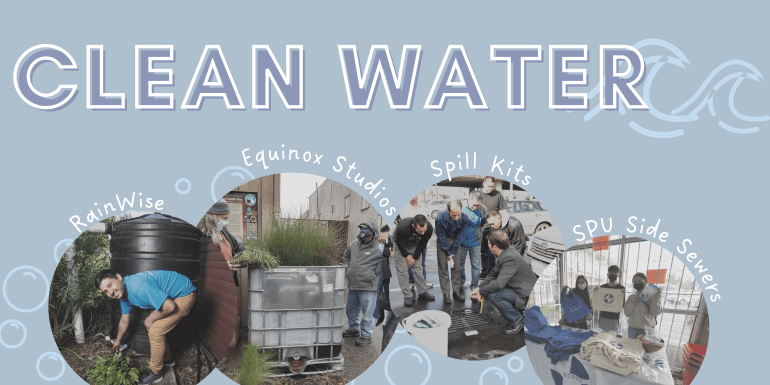
Joycelyn supported Mr. Liang in constructing Grattix boxes (rain garden in a box) at Equinox Studios. Photo Credit: William Chen / ECOSS.
How have your views on the environment evolved while working at ECOSS?
Unfortunately, my time at UW as a Fishery Sciences undergrad didn’t teach me anything about environmental injustice. Since I started working at ECOSS, I see firsthand how language barriers, technological divides, varied economic status, immigration status, etc. affect the communities we serve.
The topic of environmental protection can’t be silo-ed. There’s no way to do environmental protection, undo climate change or implement any environmental programs without addressing racial equity and social justice.
What are your biggest takeaways from your time at ECOSS?
The more you put in, the more you get out of it.
ECOSS is a lifestyle, beyond a job.
Skills learned: project management, environmental education, understanding how a nonprofit organization works.
There is so much more work to do about environmental equity!!!
Funny/memorable moments?
Group photo at the 2018 Water Festival, with emcee Aleksa Manila. Photo Credit: Sam Le.
LOTS!
Climbed up Formosan church’s roof to look at the roof structure, it was three floors high.
Water Festival. I was honestly surprised that ECOSS staff members gave me so much trust to run a festival.
Within the first month of working at ECOSS, I brought back six mooncakes. It’s meant to be shared among 4-8 people. Next day, I came to the office with one went missing. Turned out, Ruben ate a whole mooncake alone!!!
A RainWise contractor gave me two pounds of squid as token of appreciation
Doing outreach while having dim sum.
Did a simple photo shoot with Seattle Public Utilities. Next thing I knew, my face appeared in a lot of their collateral materials. Like their calendar, residential newsletter, website, even on The Stranger!
During the last week of my job, I had to help the RainWise team with running the contractor orientation. Charles’s ran into technical difficulties and ALL his PowerPoint slides lost audio tracks 15 minutes before the online orientation. We had to immediately pivot into narrating the slides! It worked great though 🙂
Where do you think the organization is headed? Or what do you hope to see in five years?
Be one of the leaders of environmental equity in Seattle.
Continue to be the cradle of environmental equity leaders.
Anything else you want to say?
The ECOSS experience is one of best things that has happened to me. I’m sad yet excited to leave to embark my next chapter of life. Thank you ECOSS!!!
We shall meet again someday! 後會有期!
Thank you Joycelyn for being part of the ECOSS family! We wish you well in your next adventures and look forward to seeing your future successes!
In response the the COIVD-19 pandemic, ECOSS adapted its strengths in multicultural outreach to help businesses stay afloat and communities stay healthy. ECOSS staff have deep, trusted relationships with the businesses and communities they work with, which was critical during the early stages of the COVID-19 outbreak.
Informed and assisted restaurants about City of Seattle’s Business Stabilization grants; 15 of these restaurants were among the selected grantees: Addis Market, Canton Noodle House, East African Grocery, Pho Hanoi Restaurant, Rain Café, Safari Njema Restaraunt, Thanh Thanh Cafe, Thien Phat Restaurant, Time Bistro, Yummy House Bakery, Blue Heron Café, Oak Tree Teriyaki, Teriyaki Plus, U DupBop, Rainier Teriyaki.
Delivered information and resources to over 80 restaurants and grocery stores in nine languages.
Provided translations and interpretation of coronavirus health literacy materials in Amharic, Korean, Cantonese, Mandarin and Vietnamese.
Trained Vietnamese community members in conducting wellness checks via phone and worked with a temple in White Center to distribute masks.
Created audio transcriptions of business loan information and coronavirus-related materials.
Many of the same disparities that lead to environmental injustices and inequities are drivers of health inequities: language access, digital literacy and geographical location, among others. For immigrants, refugees, non-native English speakers and other underserved communities, these disparities are being magnified during the novel coronavirus outbreak.
ECOSS has leaned into its role as an education and community outreach expert, pivoting quickly and nimbly to meet the immediate needs of those most vulnerable during the COVID-19 crisis. However, your support will ensure ECOSS can continue to do this vital work:
ECOSS promotes environmental equity through multicultural education and outreach. By providing in-language, culturally-relevant, community-led connections to resources, services and experiences, ECOSS empowers local businesses and communities of color to be more environmentally sustainable.
This work requires innovative changes that don’t always fit neatly into grant applications and public contracts. ECOSS, like many nonprofits, relies on the support of generous individuals to provide the funding that fuels innovation.
The ECOSS family is grateful to everyone who has contributed over the last 26 years and is thrilled to announce its first Monthly Sustaining Donors: Sandhya Nakhasi and Jordan Clark! Learn more about why they give.
How did you learn about ECOSS?
I [Sandhya] volunteer with the Coalition of Immigrants, Refugees and Communities of Color (CIRCC). In their monthly meetings, they bring in representatives from other organizations to learn about how they are serving the needs of communities of color. ECOSS was featured at one such meeting and I was intrigued by the work.
Why ECOSS?
We have been looking for a local environmental and sustainability oriented nonprofit to give to for a while. We want to support an organization focused on issues locally that also incorporates the voices of people of color. When we learned that ECOSS’ staff are hired from the communities they serve, that really resonated with us.
What prompted you to give monthly?
From our experience with the nonprofit sector, we know that continual giving contributes unrestricted funding that allows for capacity building, which will promote and sustain programs.
What are your thoughts about giving during this crisis?
This pandemic has revealed the massive inequities that we see in our society today, that have been persisting for many generations. Nonprofits are working hard every day to fill these gaps in the absence of services and support, while also trying to change the way our systems operate and ensure that a future world is able to support everyone.
If people have the capacity to support nonprofits whether they are providing direct relief or working towards systemic change, this is the time they need us most. Let’s support organizations that are building a more inclusive and sustainable future for everyone.
Thank you so much Sandhya and Jordan for your generosity and your contribution towards environmental justice and racial equity!
Sustaining donations support local businesses, communities of color and a healthier environment for all.