

ORCA Success Stories: ECOSS and Villa Comunitaria Work Together for Community Transportation Access
ECOSS partnered with Villa Comunitaria to distribute pre-loaded ORCA cards to communities as part of a research study with King County Metro, and to spread awareness about the ORCA LIFT program to bridge the barriers that many communities face when trying to sign up. ORCA LIFT is a program that helps qualifying low-income individuals have access to reduced transit fares and an ORCA card, which can be used to travel on Sound Transit, Community Transit, Everett Transit, King County Metro buses, Kitsap Transit, Pierce Transit, Seattle Streetcar, Seattle Monorail, the King County Water Taxi, and Washington State Ferries.
Villa Comunitaria is a local organization based in South Park that empowers families in innovative ways that are culturally relevant by creating a welcoming environment and providing programming that helps Latino communities navigate housing, immigration, health, education, and the legal system. We chatted with Shandiny Gualip Contreras, System Navigation Coordinator from Villa Comunitaria, to explore their experience collaborating on this ORCA card distribution/ORCA LIFT referral project, as well as the challenges, successes, and the impact on the communities Villa Comunitaria serves.
“I have felt supported by ECOSS during this work project; both through the outreach opportunities as well as the check-ins and questions with the project leads.” Shandiny shared. A big challenge that Villa Comunitaria experienced last winter was a slowdown in outreach opportunities during the holiday season and noticed that hosting tabling events together with ECOSS was a great opportunity to engage the community beyond in-office appointments. “When we tabled together, we had a greater opportunity for people to learn about the organizations and in extension – our other programs. Our teams strategized to engage in ORCA Adult Cards and LIFT Referrals respectively, which helped us engage with our visitors effectively.” Together, ECOSS and Villa Comunitaria distributed 59 (and counting) pre-loaded ORCA cards ranging in value from $25-$99.
“We welcome resources and programs like this one,that can provide our community direct assistance. Within this distribution, the participants were able to receive cards with some funds included, which alleviates an urgent need. This tangible support can also be encouraging for community members to learn how to use an ORCA card, try out the transit services available, and practice a new tool without using personal funds. I think this overall aligns with how we aim to service our community – providing tools and resources that implement beneficial practices! ”
Shandiny Gualip Contreras, Villa Comunitaria

Shandiny shared that the greatest impacts of this program were the direct temporary financial relief for community members who rely on public transportation. “We saw this impact in the higher volume of participants for ORCA Adult cards which were on hand and more accessible in terms of (absent) prerequisites. For the ORCA LIFT Referral program, our community members received support from Miguel Urquiza, our point of contact from King County Public Health, who received referral applications, provided follow-up communication, and assisted with registration.” A challenge for ORCA LIFT referrals was the registration process, due to the application process requiring personal information and/or state-related program qualifications which caused sign up rates to be lower.
In terms of ORCA improving environmental justice efforts and connecting the community, Shandiny suggested providing education on Non-public Charge and Public Charge and its relevance for ORCA LIFT. “This reissued rule has greatly impacted our communities’ comfort in accepting state or local program assistance. Oftentimes our undocumented community members are barred from state and city programs – and there is still distrust or discomfort when faced with an application that may include a Social Security Number as a listed question.” Public Health Staff enroll many people new to the country on the program every day, and Immigration status is not a factor in LIFT eligibility, since LIFT is not subject to the Public Charge rule. Many of these discomforts and concerns that community members have around the application process could be addressed and clarified at the first point of contact in the future, for example, that LIFT eligibility does not require a SSN.
Villa Comunitaria’s Bilingual Resource Specialist, Alex Segura, noticed during our appointment-based outreach that folks who initially requested the ORCA LIFT program survey would later decline or feel discomfort. “Those community members who declined the LIFT program would oftentimes opt for the regular Adult ORCA cards.” For those who did submit LIFT referral forms Public Health staff member Miguel Urquiza would verify their eligibility and issue the card. For the referrals where information was not complete multiple follow-up attempts were made to reach the client to enroll them in ORCA LIFT.
“For the folks that have recently migrated to the US, options to refill their ORCA cards are quite limited. Many do not have bank accounts set up and would only be able to refill using cash which could also hinder how effective having an ORCA card is to them.” Throughout this project, Villa Comunitaria took observations, trends and insight alike to the Reflection Sessions hosted by King County Metro.
“Partnering with ECOSS and Villa Comunitaria has been a great learning opportunity for Metro. It’s critical that we hear directly from riders about the challenges they face in accessing public transit,” said Tim Hams, co-lead for the King County Metro project. “To hear that some undocumented community members may be apprehensive about applying for ORCA LIFT or related programming because they fear retaliation, is critical information and helps us to design better transit experiences.”
Tim Hams, King County Metro
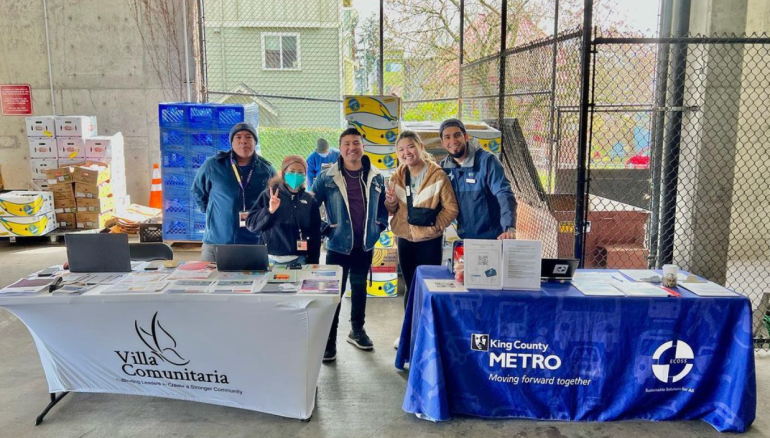
Looking ahead to future collaborations, Shandiny shared that engaging with young adults and youth education to uplift the South Park community is something to aim for. “Most of Villa Comunitaria’s programs serve adults, and direct education for young folks is limited to our Early Learning Co-op and Kaleidoscope programs at the moment. I can see the potential impact of ECOSS’s youth programs and environmental opportunities can uplift the South Park community both long-term and holistically via multi-generational engagement as Villa Comunitaria continues to service our parent and adult communities, and grow programmatically.” These partnerships have helped introduce more community members to the ORCA and LIFT programs and improved ORCA distribution efforts.
To learn more about Villa Comunitaria, visit their website: www.villacomunitaria.org
The ORCA distribution program and ORCA LIFT referral program are made possible through our partnership with King County Metro.
Read more about this program on Metro’s blog.


